Showing posts with label Navy Cross. Show all posts

Friday, June 18, 2010

Meet Brian Chontosh


Those of you who might not know, the man on the left is the Commandant of the Marine Corps, and he is proud to know the man on the right.
Maybe you'd like to hear about a real American, somebody who honored the uniform he wears.
Meet Brian Chontosh, Churchville-Chili Central School Class of 1991.
Husband and about-to-be father. First Lieutenant (now Captain) in the United States Marine Corps. And a genuine hero, the Secretary of the Navy said so.
At 29 Palms in California Brian Chontosh was presented with the Navy Cross, the second highest award for combat bravery the United States can bestow.
That's a big deal. But you won't see it on the network news tonight
And all you'll read in Brian's hometown newspaper is two paragraphs of nothing. The odd fact about the American media in this war is that it's not covering the American military. The most plugged-in nation in the world is receiving virtually no true information about what it's warriors are doing.
Oh, sure, there's a body count. We know how many Americans have fallen. And we see those same casket pictures day in and day out.
And we're almost on a first-name basis with the jerks who abused the Iraqi prisoners. And we know all about improvised explosive devices and how we lost Fallujah and what Arab public-opinion polls say about us and how the world hates us. We get a non-stop feed of gloom and doom but we don't hear about the heroes. The incredibly brave GIs who honorably do their duty. The ones our grandparents would have carried on their shoulders down Fifth Avenue ..
The ones we completely ignore, like Brian Chontosh. It was on the march into Baghdad. Brian Chontosh was a platoon leader rolling up Highway 1 in a humvee.
When all hell broke loose, ambush city. The young Marines were being cut to ribbons. Mortars, machine guns, rocket propelled grenades.And the kid out of Churchville was in charge. It was do or die and it was up to him. So he moved to the side of his column, looking for a way to lead his men to safety. As he tried to poke a hole through the Iraqi line his humvee came under direct enemy machine gun fire. It was fish in a barrel and the Marines were the fish. And Brian Chontosh gave the order to attack...

He told his driver to floor the Humvee directly at the machine gun emplacement that was firing at them. And he had the guy on top with the 50 cal unload on them.
Within moments there were Iraqis slumped across their machine guns and Chontosh was still advancing, ordering his driver now to take the Humvee directly into the Iraqi trench that was attacking his Marines.
Over into the battlement the Humvee went and out the door Brian Chontosh bailed, carrying an M16, a Beretta M9 and 228 years of Marine Corps pride.
And he ran along the trench, with its mortars and riflemen, machine guns and grenadiers. And he killed them all. He fought with the M16 until it was out of ammo. Then he fought with the Beretta until it was out of ammo. Then he picked up a dead man's AK47 and fought with that until it was out of ammo.
Then he picked up another dead man's AK47 and fought with that until it was out of ammo. At one point he even fired a discarded Iraqi RPG into an enemy cluster, sending attackers flying with its grenade explosion.
When he was done Brian Chontosh had cleared 200 yards of entrenched Iraqis from his platoon's flank. He had killed more than 20 and wounded at least as many more.
But that's probably not how he would tell it. He would probably merely say that his Marines were in trouble, and he got them out of trouble. Ooh-rah, and drive on.
"By his outstanding display of decisive leadership, unlimited courage in the face of heavy enemy fire, and utmost devotion to duty, 1st Lt. Chontosh reflected great credit upon himself and upheld the highest traditions of the Marine Corps and the United States Naval Service."
That's what the citation says. And that's what nobody will hear.That's what doesn't seem to be making the evening news.
Accounts of American valor are dismissed by the press as propaganda, yet accounts of American difficulties are heralded as objectivity. It makes you wonder if the role of the media is to inform or to depress - to report or to deride. To tell the truth, or to feed us lies.

But I guess it doesn't matter. We're going to turn out all right as long as men like Brian Chontosh wear our uniform.

Thursday, June 3, 2010

Sargeant John Basilone 1916-1945


Manila John’ Basilone was the only enlisted Marine to receive the Medal of Honor and the Navy Cross during WWII. Sergeant Basilone took on 3,000 Japanese troops on Guadalcanal to earn the Medal of Honor. A few months later Gunnery Sergeant Basilone requested to return to combat and he would give his life in the battle for Iwo Jima. He is one of the toughest men ever to claim the title Marine. Please take a moment to read the two citations of a hero.

Citation – Medal of Honor

For extraordinary heroism and conspicuous gallantry in action against enemy Japanese forces, above and beyond the call of duty, while serving with the 1st Battalion, 7th Marines, 1st Marine Division in the Lunga Area. Guadalcanal, Solomon Islands, on 24 and 25 October 1942. While the enemy was hammering at the Marines' defensive positions, Sgt. Basilone, in charge of 2 sections of heavy machineguns, fought valiantly to check the savage and determined assault. In a fierce frontal attack with the Japanese blasting his guns with grenades and mortar fire, one of Sgt. Basilone's sections, with its guncrews, was put out of action, leaving only 2 men able to carry on. Moving an extra gun into position, he placed it in action, then, under continual fire, repaired another and personally manned it, gallantly holding his line until replacements arrived. A little later, with ammunition critically low and the supply lines cut off, Sgt. Basilone, at great risk of his life and in the face of continued enemy attack, battled his way through hostile lines with urgently needed shells for his gunners, thereby contributing in large measure to the virtual annihilation of a Japanese regiment. His great personal valor and courageous initiative were in keeping with the highest traditions of the U.S. Naval Service.

Citation – Navy Cross

For extraordinary heroism while serving as a Leader of a Machine-Gun Section, Company C, 1st Battalion, 27th Marines, 5th Marine Division, in action against enemy Japanese forces on Iwo Jima in the Volcano Islands, 19 February 1945. Shrewdly gauging the tactical situation shortly after landing when his company's advance was held up by the concentrated fire of a heavily fortified Japanese blockhouse, Gunnery Sergeant Basilone boldly defied the smashing bombardment of heavy caliber fire to work his way around the flank and up to a position directly on top of the blockhouse and then, attacking with grenades and demolitions, single handedly destroyed the entire hostile strong point and its defending garrison. Consistently daring and aggressive as he fought his way over the battle-torn beach and up the sloping, gun-studded terraces toward Airfield Number 1, he repeatedly exposed himself to the blasting fury of exploding shells and later in the day coolly proceeded to the aid of a friendly tank which had been trapped in an enemy mine field under intense mortar and artillery barrages, skillfully guiding the heavy vehicle over the hazardous terrain to safety, despite the overwhelming volume of hostile fire. In the forefront of the assault at all times, he pushed forward with dauntless courage and iron determination until, moving upon the edge of the airfield, he fell, instantly killed by a bursting mortar shell. Stouthearted and indomitable, Gunnery Sergeant Basilone, by his intrepid initiative, outstanding skill, and valiant spirit of self-sacrifice in the face of the fanatic opposition, contributed materially to the advance of his company during the early critical period of the assault, and his unwavering devotion to duty throughout the bitter conflict was an inspiration to his comrades and reflects the highest credit upon Gunnery Sergeant Basilone and the United States Naval Service. He gallantly gave his life in the service of his country.

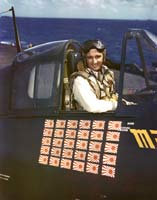
Captain David McCampbell, USN, (1910-1996)


David McCampbell was born on 16 January 1910 in Bessemer, Alabama. Appointed to the Naval Academy from Florida, he graduated in June 1933. However, economy measures resulting from the Great Depression delayed receipt of his commission as an Ensign in the regular Navy until a year later. Reporting to USS Portland, he later served with Scouting Squadron Eleven on board that cruiser. In May 1937, he was promoted to Lieutenant Junior Grade and soon began flight training at Naval Air Station, Pensacola, Florida. Designated a Naval Aviator in April 1938, he served with Fighting Squadron Four (VF-4) on USS Ranger. Later transferred to the Air Group on the new aircraft carrier Wasp, McCampbell was promoted to Lieutenant in May 1941. On 15 September 1942, during the Guadalcanal Campaign, Wasp was sunk by Japanese submarine I-19. A month later he was promoted to Lieutenant Commander and returned to the United States, subsequently serving at Naval Air Stations at Jacksonville and Melbourne, Florida.

Prior to his January 1944 promotion to Commander, McCampbell commanded Fighting Squadron 15 (VF-15), attached to USS Essex, and shortly afterwards was placed in charge of that ship's air group. Leading his aviators against an attacking force of eighty Japanese aircraft during the Battle of the Philippine Sea on 19 June 1944, he destroyed seven of the enemy planes. Four months later, during the Battle of Leyte Gulf on 24 October, he shot down nine more, disorganizing a sixty plane hostile strike group. For his "conspicuous gallantry and intrepidity" on these occasions, McCampbell was awarded the Medal of Honor. During his tour of duty as Essex's Air Group Fifteen, he became the U.S. Navy's leading ace, credited with downing a total of 34 Japanese aircraft. The entire air group was credited with 315 planes shot down in aerial combat, 348 more destroyed on the ground, nearly 300,000 tons of enemy shiping sunk and an even greater tonnage damaged.

From March 1945 until January 1947, McCampbell served as Chief of Staff to Commander, Fleet Air, Quonset Point, and as Commander, Carrier Air Groups, Hampton Roads, Virginia. He was then at the Armed Forces Staff College as both a student and as a staff member. In October 1948, he became the Senior Naval Aviation Advisor to the Argentine Navy. Service as Executive Officer of USS Franklin D. Roosevelt followed during most of 1951 and into the following year. Assigned to the Headquarters of Commander Aircraft Atlantic at Norfolk in March 1952, McCampbell was promoted to Captain in July. The following summer, he commanded the Naval Air Technical Training Center at Jacksonville, Florida, then had duty as Flight Test Coordinator at Naval Air Test Center, Patuxent River, Maryland. After a 1956-1958 tour with Commander, Sixth Fleet, he was Captain of the oiler Severn and, in 1959-1960, the aircraft carrier Bon Homme Richard. Beginning in May 1960, he served in the Nation's Capital with the Joint Chiefs of Staff and the Bureau of Naval Personnel. In August 1962, Captain McCampbell received orders to the staff of Commander in Chief, Continental Air Defense Command. He retired from active duty in 1964. David McCampbell died on 30 June 1996 and is buried at Arlington National Cemetery, Arlington, Virginia.