Showing posts with label Army. Show all posts

Monday, August 23, 2010

Sergeant Alvin Cullum York 1887 – 1964


Alvin Cullum York (December 13, 1887 – September 2, 1964) was the most decorated American soldier in World War I. He received the Medal of Honor for leading an attack on a German machine gun nest, taking 32 machine guns, killing 28 German soldiers and capturing 132 others. This action occurred during the U.S.-led portion of the Meuse-Argonne Offensive in France, which was part of a broader Allied offensive masterminded by Marshal Ferdinand Foch to breach the Hindenburg line and ultimately force the opposing German forces to capitulate.

Alvin Cullum York was born in a two-room log cabin near Pall Mall, Tennessee, on December 13, 1887, the third of eleven children born to Mary Elizabeth Brooks (8 August 1866 - 21 May 1943) and William Uriah York (15 May 1863 – 17 November 1911). William Uriah York was born in Jamestown, Tennessee, to Uriah York and Eliza Jane Livingston, both travelers from Buncombe County, North Carolina. Mary Elizabeth York was born in Pall Mall, Tennessee, to William Brooks and Nancy Pile, and was the great-granddaughter of Coonrod Pile, an English settler who settled Pall Mall in Tennessee. William York and Mary Brooks married on December 25, 1881, and had eleven children. The York siblings are, in order: Henry Singleton, Joseph Marion, Alvin Cullum, Samuel John, Albert, Hattie, George Alexander, James Preston, Lillian Mae, Robert Daniel, and Lucy Erma. The York family is of English, Irish, Choctaw, and Cherokee ancestry.

The York family resided in the Indian Creek area of Fentress County. The family was impoverished, with William York working as a blacksmith, by which he supplemented the family income. The father and sons of the York family would gather and harvest their own food, while the mother knitted all family clothing. The York sons only attended nine months of schooling, and withdrew from education because William York wanted his sons to assist him in tending to the family farm and hunting small game in order to feed the family.

When William York died in November 1911, his son Alvin assisted his mother in raising his younger siblings. Alvin was the oldest living sibling that was then-residing in the county, as his two older brothers had married and moved into more urban areas in the American South. In order to supplement the family income, York first held employment as a community laborer in Harriman, Tennessee, in which he assisted in the construction of a railroad and worked as a logger as well. By all accounts, he was a very skilled worker who was devoted to the welfare of his family. However, in the few years before the war, York was a violent alcoholic and prone to fighting in saloons, and had accumulated several arrests within the area. His mother, a member of a pacifist Protestant denomination, tried to persuade York to change his ways because she worried he would "amount to nothin'", however to no avail. In the winter of 1914, he and his friend engaged in a fight with other saloon patrons during a night of heavy drinking. The incident resulted in his friend Everett Delk being beaten to death inside a saloon in Clinton County, Kentucky. The event was profound enough that York finally followed his mother's advice and became a pacifist, and stopped drinking alcohol. York was baptized as a born again Christian in the Wolf River, with the baptism being conducted by Reverend H.H. Russell in early 1915.

In 1914, York joined the Church of Christ in Christian Union, a Protestant denomination, which had no specific doctrine of pacificism but opposed warfare and violence by all means. In a lecture later in life, he reported his reaction to the outbreak of World War I: "I was worried clean through. I didn't want to go and kill. I believed in my bible." On June 5, 1917, at the age of 29, Alvin York registered for the draft as all men between 21 and 31 years of age did on that day. When he registered for the draft, he answered the question "Do you claim exemption from draft (specify grounds)?" by writing "Yes. Don't Want To Fight." When his initial claim for conscientious objector status was denied, he appealed.

In World War I, conscientious objector status did not exempt one from military duty. Such individuals could still be drafted and were given assignments that did not conflict with their anti-war principles. In November 1917, while York's application was considered, he was drafted and began his army service at Camp Gordon in Georgia. There, extensive conversations with Major George Buxton challenged his pacifism and its Biblical basis until York decided he could and would serve.

From the day he registered for the draft until he arrived back from the war on May 29, 1919, York kept a diary of his activities. In his diary, York wrote that he refused to sign documents provided by his pastor seeking a discharge from the Army on religious grounds. He refused to sign similar documents provided by his mother asserting a claim of exemption as the sole support of his mother and siblings. He disclaimed ever having been a conscientious objector.

York enlisted in the United States Army and served in Company G, 328th Infantry Regiment, 82nd Infantry Division at Camp Gordon, Georgia. Discussions of the Biblical stance on war with his company commander, Captain Edward Courtney Bullock Danforth (1894–1973) of Augusta, Georgia and his battalion commander, Major Gonzalo Edward Buxton (1880–1949) of Providence, Rhode Island, eventually convinced York that warfare could be justified.

During an attack by his battalion to secure German positions along the Decauville rail-line north of Chatel-Chehery, France, on October 8, 1918, York's actions earned him the Medal of Honor. He recalled: "The Germans got us, and they got us right smart. They just stopped us dead in our tracks. Their machine guns were up there on the heights overlooking us and well hidden, and we couldn’t tell for certain where the terrible heavy fire was coming from… And I'm telling you they were shooting straight. Our boys just went down like the long grass before the mowing machine at home. Our attack just faded out… And there we were, lying down, about halfway across [the valley] and those German machine guns and big shells getting us hard."

Four non-commissioned officers and thirteen privates under the command of Sergeant Bernard Early (which included York) were ordered to infiltrate behind the German lines to take out the machine guns. The group worked their way behind the Germans and overran the headquarters of a German unit, capturing a large group of German soldiers who were preparing a counter-attack against the U.S. troops. Early’s men were contending with the prisoners when machine gun fire suddenly peppered the area, killing six Americans: Corp. Murray Savage, and Pvts. Maryan E. Dymowski, Ralph E. Weiler, Fred Waring, William Wins and Walter E. Swanson, and wounding three others, Sgt. Early, Corp. William S. Cutting (AKA Otis B. Merrithew) and Pvt. Mario Muzzi. The fire came from German machine guns on the ridge, which turned their weapons on the U.S. soldiers. The loss of the nine put Corporal York in charge of the seven remaining U.S. soldiers, Privates Joseph Kornacki, Percy Beardsley, Feodor Sok, Thomas C. Johnson, Michael A. Saccina, Patrick Donohue and George W. Wills. As his men remained under cover, and guarding the prisoners, York worked his way into position to silence the German machine guns.

York recalled: "And those machine guns were spitting fire and cutting down the undergrowth all around me something awful. And the Germans were yelling orders. You never heard such a racket in all of your life. I didn't have time to dodge behind a tree or dive into the brush… As soon as the machine guns opened fire on me, I began to exchange shots with them. There were over thirty of them in continuous action, and all I could do was touch the Germans off just as fast as I could. I was sharp shooting… All the time I kept yelling at them to come down. I didn't want to kill any more than I had to. But it was they or I. And I was giving them the best I had."

York, at the hill where his actions earned him the Medal of Honor, three months after the end of World War I on February 7, 1919

During the assault, a group of eight German soldiers in a trench near York were ordered to charge him with fixed bayonets. York had fired all the rounds in his rifle, but drew out his pistol and shot all eight of the soldiers before they could reach him.

One of York’s prisoners, German First Lieutenant Paul Jürgen Vollmer (who spoke fluent English) of 1st Battalion, 120th Württemberg Landwehr Regiment, emptied his pistol trying to kill York while he was contending with the machine guns. Failing to injure York, and seeing his mounting losses, he offered to surrender the unit to York, who gladly accepted. By the end of the engagement, York and his seven men marched 132 German prisoners back to the American lines. His actions silenced the German machine guns and were responsible for enabling the 328th Infantry to renew its attack to capture the Decauville Railroad.

York was awarded the Distinguished Service Cross for his heroism, but this was upgraded to the Medal of Honor, which was presented to York by the commanding general of the American Expeditionary Force, General John J. Pershing. The French Republic awarded him the Croix de Guerre and Legion of Honor. Italy and Montenegro awarded him the Croce di Guerra and War Medal, respectively.

York was a corporal during the action. His promotion to sergeant was part of the honor for his valor. Of his deeds, York said to his division commander, General George B. Duncan, in 1919: "A higher power than man power guided and watched over me and told me what to do."

Awards: Medal of Honor, Distinguished Service Cross, World War I Victory Medal, American Campaign Medal, World War II Victory Medal, French Légion d'honneur, French Croix de guerre with Palm, Italian Croce di Guerra, Montenegrin War Medal

On June 7, 1919, Alvin C. York and Gracie Loretta Williams (February 7, 1900 - September 27, 1984) were married by Tennessee Governor Albert H. Roberts in Pall Mall. They had seven children, all named after American historical figures: five sons (Alvin Cullum, Jr., Edward Buxton, Woodrow Wilson, Andrew Jackson, and Thomas Jefferson) and two daughters (Betsy Ross and Mary Alice).

York founded the Alvin C. York Agricultural Institute, a private agricultural school in Jamestown, Tennessee, that was eventually turned over to the State of Tennessee. The school, now known as Alvin C. York Institute, is the only fully state-funded public high school in the State of Tennessee. The school is a nationally recognized school of excellence and boasts the highest high school graduation percentage in the state. It is home to almost 800 students.

York also opened a Bible school and later operated a mill in Pall Mall on the Wolf River.

Alvin York died at the Veterans Hospital in Nashville, Tennessee, on September 2, 1964, of a cerebral hemorrhage and was buried at the Wolf River Cemetery in Pall Mall. His funeral sermon was delivered by Richard G. Humble, General Superintendent of the Churches of Christ in Christian Union. Humble also preached Mrs. York's funeral in 1984.

York's son, Thomas Jefferson York, was killed in the line of duty on May 7, 1972 while serving as a constable in Tennessee.

Medal of Honor Citation
Rank and organization: Corporal, U.S. Army, Company G, 328th Infantry, 82d Division. Place and date: Near Chatel-Chehery, France, 8 October 1918. Entered service at: Pall Mall, Tenn. Born: 13 December 1887, Fentress County, Tenn. G.O. No.: 59, W.D., 1919. Citation: After his platoon had suffered heavy casualties and 3 other noncommissioned officers had become casualties, Cpl. York assumed command. Fearlessly leading 7 men, he charged with great daring a machinegun nest which was pouring deadly and incessant fire upon his platoon. In this heroic feat the machinegun nest was taken, together with 4 officers and 128 men and several guns.

Wednesday, August 4, 2010

Sergeant First Class Randall 'Randy' David Shughart 1958 – 1993


Sergeant First Class Randall 'Randy' David Shughart (August 13, 1958–October 3, 1993) was a soldier in the United States Army special operations unit, the 1st Special Forces Operational Detachment-Delta (1SFOD-D), or "Delta Force." Shughart posthumously received the Medal of Honor for his actions during the Battle of Mogadishu in October 1993.

Randy Shughart was born on August 13, 1958 in Lincoln, Nebraska into an Air Force family. His father, Herbert Shughart, was stationed nearby. The Shugharts moved to Newville, Pennsylvania after Herb left the Air Force, living on and tending a dairy farm. Randy joined the Army while attending Big Spring High School in Newville, entering upon graduation. After basic training, he successfully completed AIT (advanced individual training), Airborne School, and afterwards was assigned to the 2nd Ranger Battalion, 75th Infantry (Airborne), at Fort Lewis, Washington. Several months later he completed a pre-ranger course (currently known as RIP, or Ranger Indoctrination Program), was granted a slot to attend Ranger School, graduated, and therefore earned the Ranger Tab. After leaving the service, then again reenlisting into the Rangers, Shughart was later assigned to "Delta Force" and was transferred to Fort Bragg, North Carolina.

Shughart was deployed to Mogadishu, Somalia with other Delta members in the summer of 1993 as part of Task Force Ranger. On October 3, 1993 Shughart was Sniper Team Leader during Operation Gothic Serpent, a joint-force assault mission to apprehend key advisers to Somali warlord Mohamed Farrah Aidid. During the assault, Super Six One, one of the Army's Black Hawk helicopters providing insertion and air support to the assault team, was shot down and had crashed in the city. A Combat Search and Rescue (CSAR) team was dispatched to the first crash site to secure it. Shortly thereafter, Super Six Four was shot down as well. Ranger forces on the ground were not able to assist the downed helicopter crew of the second crash site as they were already engaged in heavy combat with Aidid's militia and making their way to the first crash site.

Shughart and his Delta sniper teammates Gary Gordon and Sergeant First Class Brad Hallings had been providing sniper cover from the air. Gary Gordon requested to be inserted on the ground in order to secure the crash site and protect survivors, despite the fact that large numbers of armed, hostile Somalis were converging on the area.

Mission commanders denied Gordon's request twice, saying that the situation was already too dangerous for the three Delta snipers to effectively protect the Blackhawk crew from the ground. Command's position was that the snipers could be of more assistance by continuing to provide air cover. Gordon, however, concluded that there was no way the Black Hawk crew could survive on their own, and repeated his request twice until he finally received permission. Sergeant First Class Brad Hallings, who had assumed control of a minigun after a crew chief was injured, remained on the helicopter to provide cover from the air.

Gordon and Shughart were inserted approximately 100m from the crash site, armed with only their sniper rifles and sidearms, and made their way to the location of the downed Blackhawk. Chief Warrant Officer Mike Durant was already engaged in defending the downed aircraft with an MP5 but was unable to move from his pilot chair due to a crushed vertebrae in his back and a compound fracture of his left femur. When Gordon and Shughart reached Super Six Four, they extracted Durrant and the other crew members from the aircraft and established defensive positions around the crash.

It is believed that Gordon was first to be shot by the mob, which had surrounded the crash site. His teammate Shughart retrieved Gordon's CAR-15 assault rifle and gave it to Durant to use. Shortly after, Shughart was killed, the site was overrun and Durant was beaten by the mob before being taken hostage. Immediately after the firefight, the Somalis counted 24 of their own men dead with many more severely wounded who may have died later of their wounds.

There was some confusion in the aftermath of the action as to who had been killed first. The official citation states that it was Shughart, but author Mark Bowden, author of Black Hawk Down: A Story of Modern War, the best-selling book about the October 1993 events, relates an account by Sergeant Paul Howe, another Delta operator participating in the battle. Howe said that he heard Shughart call for help on the radio and that the weapon handed to Durant was not the distinctive M14 used by Shughart. Furthermore, Howe said that Shughart would never have given his own weapon to another soldier to use while he was still able to fight.

In Durant's book, In the Company of Heroes, he states that Gordon was on the left side of the Blackhawk, after both he and Shughart moved Durant to a safer location, and only heard Gordon say, "Damn, I'm hit." Afterwards Shughart came from the left side of the Blackhawk with the CAR-15.

Shughart is buried in Westminster Cemetery, Carlisle, PA.

Medal of Honor citation
Rank and organization: Sergeant First Class, U.S. Army. Place and date: 3 October 1993, Mogadishu, Somalia. Entered service at: ----- Born: Newville, Pennsylvania. Citation: Sergeant First Class Shughart, United States Army, distinguished himself by actions above and beyond the call of duty on 3 October 1993, while serving as a Sniper Team Member, United States Army Special Operations Command with Task Force Ranger in Mogadishu, Somalia. Sergeant First Class Shughart provided precision sniper fires from the lead helicopter during an assault on a building and at two helicopter crash sites, while subjected to intense automatic weapons and rocket propelled grenade fires. While providing critical suppressive fires at the second crash site, Sergeant First Class Shughart and his team leader learned that ground forces were not immediately available to secure the site. Sergeant First Class Shughart and his team leader unhesitatingly volunteered to be inserted to protect the four critically wounded personnel, despite being well aware of the growing number of enemy personnel closing in on the site. After their third request to be inserted, Sergeant First Class Shughart and his team leader received permission to perform this volunteer mission. When debris and enemy ground fires at the site caused them to abort the first attempt, Sergeant First Class Shughart and his team leader were inserted one hundred meters south of the crash site. Equipped with only his sniper rifle and a pistol, Sergeant First Class Shughart and his team leader, while under intense small arms fire from the enemy, fought their way through a dense maze of shanties and shacks to reach the critically injured crew members. Sergeant First Class Shughart pulled the pilot and the other crew members from the aircraft, establishing a perimeter which placed him and his fellow sniper in the most vulnerable position. Sergeant First Class Shughart used his long range rifle and side arm to kill an undetermined number of attackers while traveling the perimeter, protecting the downed crew. Sergeant First Class Shughart continued his protective fire until he depleted his ammunition and was fatally wounded. His actions saved the pilot's life. Sergeant First Class Shughart's extraordinary heroism and devotion to duty were in keeping with the highest standards of military service and reflect great credit upon him, his unit and the United States Army.

Tuesday, August 3, 2010

Master Sergeant Gary Ivan Gordon 1960 – 1993


Gary Gordon was born August 30, 1960 in Lincoln, Maine and graduated from Mattanawcook Academy in 1978. He joined the U.S. Army that same year at age 18 and after serving with the 2nd Battalion of the 10th Special Forces Group he was chosen to join the 1st Special Forces Operational Detachment-Delta (1SFOD-D), or "Delta Force" as a sniper. Before deploying with his unit to Somalia he married his wife Carmen and together they had two children.

Gordon was deployed to Mogadishu, Somalia with other Delta members in the summer of 1993 as part of Task Force Ranger. On October 3, 1993 Gordon was Sniper Team Leader during Operation Gothic Serpent, a joint-force assault mission to apprehend key advisers to Somali warlord Mohamed Farrah Aidid. During the assault, Super Six One, one of the Army's Black Hawk helicopters providing insertion and air support to the assault team, was shot down and crashed in the city. A Combat Search and Rescue team was dispatched to the first crash site to secure it and a short time later Super Six Four was shot down as well. Ranger forces on the ground were not able to assist the downed helicopter crew of the second crash site as they were already engaged in heavy combat with Aidid's militia and making their way to the first crash site.
Gordon and his Delta Force sniper teammates Sergeant First Class Randall Shughart and Sergeant First Class Brad Hallings, who were providing sniper cover from the air, wanted to be dropped at the second crash site in order to protect the four critically wounded crew, despite the fact that large numbers of armed, hostile Somalis were converging on the area. Mission commanders denied Gordon's request, saying that the situation was already too dangerous for the three Delta snipers to effectively protect the Blackhawk crew from the ground. Command's position was that the snipers could be of more assistance by continuing to provide air cover. Gordon, however, concluded that there was no way the Black Hawk crew could survive on their own, and repeated his request twice until he finally received permission. Sergeant First Class Brad Hallings had assumed control of a minigun after a crew chief was injured and was not inserted with Shughart and Gordon.

Once on the ground, Gordon and Shughart, armed with only their personal weapons and sidearms, fought their way to the downed Blackhawk. By this time more Somalis were arriving who were intent on either capturing or killing the American servicemen. When they reached Super Six Four, Gordon and Shughart extracted the pilot, Chief Warrant Officer Mike Durant and the other crew members from the aircraft, and established defensive positions around the crash. Despite having inflicted heavy casualties against the Somalis, the two Delta snipers were too outnumbered and outgunned. Their ammunition nearly depleted, Gordon and Shughart finally were killed by Somali gunfire. It is believed that Gordon was first to be fatally wounded. His teammate Shughart retrieved Gordon's CAR-15 assault rifle and gave it to Durant to use. Shortly after, Shughart was killed and Durant was taken alive. Immediately after the battle, the Somalis counted 24 of their own men dead with many more severely wounded who may have died later of their wounds.

He died there in Somalia October 3, 1993 and is buried in Lincoln Cemetery, Penobscot County, Maine.

There was some confusion in the aftermath of the action as to who had been killed first. The official citation states that it was Shughart, but author Mark Bowden, author of Black Hawk Down: A Story of Modern War, the book about the October 1993 events, relates an account by Sergeant Paul Howe, another Delta operator participating in the battle. Howe said that he heard Shughart call for help on the radio and that the weapon handed to Durant was not the distinctive M14 used by Shughart. Furthermore, Howe said that Shughart would never have given his own weapon to another soldier to use while he was still able to fight. In Durant's book, In the Company of Heroes, he states that Gordon was on the left side of the Blackhawk, after both he and Shughart moved Durant to a safer location, and only heard Gordon say, "Damn, I'm hit." Afterwards Shughart came from the left side of the Blackhawk with the CAR-15.

After the attack on the United States on September 11, 2001, United States Special Forces units were inserted into Afghanistan to assist the Northern Alliance forces in overthrowing the Taliban and Al-Qaeda terrorists. Following an intense mountain battle known as Operation Anaconda in March 2002, U.S. troops searching a bunker complex found a GPS unit and holding pouch labeled "G. Gordon". Intelligence analysts believed at first this was Sergeant Gordon's GPS unit that he purchased on the private market and used in Somalia. The Gordon family was notified immediately of the find prior to the information being released to the public. It ultimately turned out that it wasn't Gordon's GPS but one of a helicopter pilot lost in an earlier fight during Operation Anaconda.

MSG Gordon's personal decorations include:
During his military career he earned the following military decorations: Medal of Honor, Purple Heart, Meritorious Service Medal, Army Commendation Medal, Joint Service Achievement Medals (x2), Good Conduct Medal (x4), Combat Infantryman Badge, Master Parachutist Badge, Ranger Tab, Special Forces Tab, French Army Mountaineering Badge, the Royal Danish Parachutist Badge and the Joint Meritorious Unit Award.

Medal of Honor Citation

Rank and organization: Master Sergeant, U.S. Army. Place and date: 3 October 1993, Mogadishu, Somalia. Entered service at: ----- Born: Lincoln, Maine. Citation: Master Sergeant Gordon, United States Army, distinguished himself by actions above and beyond the call of duty on 3 October 1993, while serving as Sniper Team Leader, United States Army Special Operations Command with Task Force Ranger in Mogadishu, Somalia. Master Sergeant Gordon's sniper team provided precision fires from the lead helicopter during an assault and at two helicopter crash sites, while subjected to intense automatic weapons and rocket propelled grenade fires. When Master Sergeant Gordon learned that ground forces were not immediately available to secure the second crash site, he and another sniper unhesitatingly volunteered to be inserted to protect the four critically wounded personnel, despite being well aware of the growing number of enemy personnel closing in on the site. After his third request to be inserted, Master Sergeant Gordon received permission to perform his volunteer mission. When debris and enemy ground fires at the site caused them to abort the first attempt, Master Sergeant Gordon was inserted one hundred meters south of the crash site. Equipped with only his sniper rifle and a pistol, Master Sergeant Gordon and his fellow sniper, while under intense small arms fire from the enemy, fought their way through a dense maze of shanties and shacks to reach the critically injured crew members. Master Sergeant Gordon immediately pulled the pilot and the other crew members from the aircraft, establishing a perimeter which placed him and his fellow sniper in the most vulnerable position. Master Sergeant Gordon used his long range rifle and side arm to kill an undetermined number of attackers until he depleted his ammunition. Master Sergeant Gordon then went back to the wreckage, recovering some of the crew's weapons and ammunition. Despite the fact that he was critically low on ammunition, he provided some of it to the dazed pilot and then radioed for help. Master Sergeant Gordon continued to travel the perimeter, protecting the downed crew. After his team member was fatally wounded and his own rifle ammunition exhausted, Master Sergeant Gordon returned to the wreckage, recovering a rifle with the last five rounds of ammunition and gave it to the pilot with the words, "good luck." Then, armed only with his pistol, Master Sergeant Gordon continued to fight until he was fatally wounded. His actions saved the pilot's life. Master Sergeant Gordon's extraordinary heroism and devotion to duty were in keeping with the highest standards of military service and reflect great credit upon him, his unit and the United States Army.

Friday, June 25, 2010

Sergeant First Class PAUL R. SMITH 1969 - 2003


Paul Ray Smith (September 24, 1969 – April 4, 2003) was a United States Army Sergeant First Class who posthumously received the Medal of Honor for his actions in Operation Iraqi Freedom. While serving with B Company, 11th Engineer Battalion, 3rd Infantry Division in Baghdad, Iraq his team was attacked by a group of enemy fighters and after a short firefight he was killed by enemy fire. For his actions during this battle he was recommended and approved for the Medal of Honor. Two years later the medal, along with the newly approved Medal of Honor flag, was presented to his family at a White House ceremony by the President of the United States George W. Bush.
Smith was born September 24, 1969 in El Paso, Texas to Donald and Janice Pvirre but when he was nine the family moved to Tampa, Florida. As a child he attended public schools and enjoyed sports especially American football. He also liked riding skateboards and bicycles, playing pranks with his friends and younger sister Lisa. In high school he became interested in carpentry, even finding a part time job as a carpenters assistant. He also liked to work on cars, especially old ones and enjoyed taking things apart to see how they worked, even restoring a dune buggy with a friend. In 1989 he graduated from Tampa Bay Vocational Tech High School and shortly after joined the United States Army in October 1989.
He was sent to Basic Training at Fort Leonard Wood, Missouri before being sent to Germany for his first duty station, where he joined the 9th Engineer Battalion. Later, he served during the Persian Gulf War. He deployed with B company in October 1996 as part of the 2nd Brigade Combat Team, the covering force for Operation Joint Endeavor and Operation Joint Guardian; the battalion returned to Schweinfurt in April 1997. In 1999 he was posted to the 11th Engineer Battalion and deployed with them to Kosovo in May 2001, were he was responsible for daily presence patrols in the town of Gnjilane. In the spring of 2002, he received a promotion to Sergeant First Class and completed the Advanced Non-Commissioned Officer Course in August 2002.
As part of the 2003 invasion of Iraq, he was assigned to B Company, 11th Engineer Battalion of the 3rd Infantry Division. His company was supporting the 2nd Battalion, 7th Infantry Regiment as it made its way through the Karbala Gap, across the Euphrates River and to Saddam International Airport (BIAP) in Baghdad. On April 4, 2003, a 100-man force was assigned to block the highway between Baghdad and the airport, about one mile east of the airport. After a brief battle, several of the enemy were captured. Smith spotted a walled enclosure nearby with a tower overlooking it. He and his squad set about building an impromptu enemy prisoner of war (EPW) holding area in the enclosure. Smith and 16 other men used an Armored Combat Earthmover (similar to a bulldozer) to knock a hole in the south wall of the courtyard. On the north side, there was a metal gate that Smith assigned several men to guard. These men noticed 50–100 enemy who had taken positions in trenches just past the gate. He summoned a Bradley fighting vehicle to attack their position. Three nearby M113 Armored Personnel Carriers came to support the attack. An M113 was hit, possibly by a mortar, and all three crewmen were wounded. The Bradley, damaged and running low on ammunition, withdrew to reload during a lull in the battle. Smith organized the evacuation of the injured M113 crewmen. However, behind the courtyard was a military aid station crowded with 100 combat casualties. To protect it from being overrun, Smith chose to fight on rather than withdraw with the wounded.
Meanwhile, some enemy had taken position in the tower overlooking the courtyard, just over the west wall. The enemy now had the Americans in the courtyard under an intense crossfire. Smith took command of the M113 and ordered a driver to position it so that he could attack both the tower and the trenches. He manned the M113's machine gun, going through three boxes of ammunition. A separate team, led by First Sergeant Tim Campbell attacked the tower from the rear, killing the enemy. As the battle ended, Smith's machine gun fell silent. His comrades found him slumped in the turret hatch. His armored vest was peppered with 13 bullet holes, the vest's ceramic armor inserts, both front and back, cracked in numerous places. But the fatal shot, one of the last from the tower, had entered his neck and passed through his brain, killing SFC Smith.
Before deploying to Iraq Smith had written to his parents, "There are two ways to come home, stepping off the plane and being carried off the plane. It doesn't matter how I come home, because I am prepared to give all that I am to ensure that all my boys make it home." Smith is buried in Arlington National Cemetery Arlington, Virginia and his grave can be found in memorial Section D, lot 67.
At the time of his death he had served for thirteen years and for his actions during the battle, he was posthumously awarded the Medal of Honor. On April 4, 2005, exactly two years after he was killed, his eleven-year-old son David received the Medal of Honor from President George W. Bush along with the Medal of Honor flag.
SFC Smith is survived by his wife Birgit, son David, and stepdaughter Jessica.
During his military career he received twenty-two military decorations and badges. A full list of his military decorations are as follows: Medal of Honor, Bronze Star, Purple Heart, Army Commendation Medal, Army Achievement Medal, Good Conduct Medal (3rd award), National Defense Service Medal, Armed Forces Expeditionary Medal, Southwest Asia Service Medal(with three bronze stars), Global War on Terrorism Service Medal, Global War on Terrorism Expeditionary Medal, Army NCO Professional Development Ribbon (2nd award), Army Service Ribbon, Overseas Service Ribbon (3rd award), NATO Medal (Kosovo), Kuwait Liberation Medal (Saudi Arabia), Kuwait Liberation Medal (Kuwait), Valorous Unit Award, Army Superior Unit Award, German Marksmanship Badge and the French Armed Forces Commando Badge.
Medal Of Honor Citation
Rank and Organization: Sergeant First Class, United States Army
For conspicuous gallantry and intrepidity at the risk of his life above and beyond the call of duty:Sergeant First Class Paul R. Smith distinguished himself by acts of gallantry and intrepidity above and beyond the call of duty in action with an armed enemy near Baghdad International Airport, Baghdad, Iraq on 4 April 2003. On that day, Sergeant First Class Smith was engaged in the construction of a prisoner of war holding area when his Task Force was violently attacked by a company-sized enemy force. Realizing the vulnerability of over 100 fellow soldiers, Sergeant First Class Smith quickly organized a hasty defense consisting of two platoons of soldiers, one Bradley Fighting Vehicle and three armored personnel carriers. As the fight developed, Sergeant First Class Smith braved hostile enemy fire to personally engage the enemy with hand grenades and anti-tank weapons, and organized the evacuation of three wounded soldiers from an armored personnel carrier struck by a rocket propelled grenade and a 60mm mortar round. Fearing the enemy would overrun their defenses, Sergeant First Class Smith moved under withering enemy fire to man a .50 caliber machine gun mounted on a damaged armored personnel carrier. In total disregard for his own life, he maintained his exposed position in order to engage the attacking enemy force. During this action, he was mortally wounded. His courageous actions helped defeat the enemy attack, and resulted in as many as 50 enemy soldiers killed, while allowing the safe withdrawal of numerous wounded soldiers. Sergeant First Class Smith’s extraordinary heroism and uncommon valor are in keeping with the highest traditions of the military service and reflect great credit upon himself, the Third Infantry Division “Rock of the Marne,” and the United States Army.

Thursday, June 24, 2010

Private First Class ROSS A. McGINNIS 1987 - 2006


Ross Andrew McGinnis (June 14, 1987 – December 4, 2006) was a soldier who served in the United States Army during the Iraq War and was posthumously awarded the United States' highest decoration for bravery, the Medal of Honor. While serving as the gunner in a HMMWV, his convoy was attacked and a hand grenade was thrown into his vehicle. McGinnis was subsequently killed in action when he threw himself on the grenade, saving the lives of at least four other soldiers in the vehicle. He was the fourth soldier to receive the Medal of Honor during the Iraq War, which was presented to his family following his death.
McGinnis was born in Meadville, Pennsylvania on June 14, 1987 to Romayne and Tom McGinnis. Although he was born in Meadville he grew up in Knox, east of Pittsburgh, after his family moved there when he was three. When he was in kindergarten, his teacher gave him a paper that at the top said "When I grow up, I want to be __________" and he wrote an "Army Man". When he was growing up he became involved in the Boy Scouts of America, enjoyed working on cars, and was an athlete playing multiple sports. He played basketball and soccer through the YMCA, and Little League baseball. He attended Clarion County public schools and although he was a marginal student, he graduated from Keystone Junior/Senior High School in 2005. He has two sisters, Becky and Katie.
McGinnis had wanted to be a soldier since kindergarten and joined the Army through the Delayed Entry Program on his 17th birthday, on June 14, 2004. Following basic training at Fort Benning, Georgia, he was assigned to the 1st Battalion, 26th Infantry Regiment, in Ledward Barracks, in Schweinfurt, Germany.[4]
In August 2006, aged 19, the regiment was deployed to eastern Baghdad and he was serving as a .50 caliber machine-gunner in a Humvee during operations against insurgents in Adhamiyah. On December 4, while his platoon was on mounted patrol in Adhamiyah, a grenade was thrown into his vehicle. He told the other four men about it, so they could prepare for the blast. Instead of jumping out of the gunning hatch, he threw his back over the grenade, absorbing the bulk of the blast. He was killed instantly, but the other occupants were able to survive with only minor injuries.
He is buried at Arlington National Cemetery in Virginia and his grave can be found in section 60, site 8544. Since the beginning of the Iraq War, he is one of four known United States servicemembers who have thrown themselves on a live grenade. The other personnel known to have done this are Marine Corporal Jason Dunham, Navy SEAL Petty Officer 2nd Class Michael A. Monsoor, and Marine Sergeant Rafael Peralta. McGinnis was the fourth recipient of the Medal of Honor in the course of the Iraq War.
A ceremony was held in the east room of the White House on June 2, 2008 in which the medal was presented to his family by President George W. Bush. In addition to his family and the President a many other notable people attended the ceremony, including the Vice President, the Secretary of Veterans Affairs James Peake, Secretary of the Army Pete Geren, Secretary of the Air Force Michael Wynne, General Jim "Hoss" Cartwright, and the Vice Chairman of the Joint Chiefs. Several members of congress also attended as did members of McGinnis' unit from Iraq, including the other soldiers from the vehicle he sacrificed his life to save.
In addition to the Medal of Honor he also received a posthumous promotion to specialist as well as the following medals and ribbons; Silver Star, Bronze Star, Purple Heart, Army Good Conduct Medal, National Defense Service Medal, Iraq Campaign Medal, Global War on Terrorism Service Medal, Army Service Ribbon, and Army Overseas Service Ribbon.
Medal Of Honor Citation
Rank and Organization: Private First Class, United States Army
For conspicuous gallantry and intrepidity at the risk of his life above and beyond the call of duty:
Private First Class Ross A. McGinnis distinguished himself by acts of gallantry and intrepidity above and beyond the call of duty while serving as an M2 .50-caliber Machine Gunner, 1st Platoon, C Company, 1st Battalion, 26th Infantry Regiment, in connection with combat operations against an armed enemy in Adhamiyah, Northeast Baghdad, Iraq, on 4 December 2006.

That afternoon his platoon was conducting combat control operations in an effort to reduce and control sectarian violence in the area. While Private McGinnis was manning the M2 .50-caliber Machine Gun, a fragmentation grenade thrown by an insurgent fell through the gunner's hatch into the vehicle. Reacting quickly, he yelled "grenade," allowing all four members of his crew to prepare for the grenade's blast. Then, rather than leaping from the gunner's hatch to safety, Private McGinnis made the courageous decision to protect his crew. In a selfless act of bravery, in which he was mortally wounded, Private McGinnis covered the live grenade, pinning it between his body and the vehicle and absorbing most of the explosion.

Private McGinnis' gallant action directly saved four men from certain serious injury or death. Private First Class McGinnis' extraordinary heroism and selflessness at the cost of his own life, above and beyond the call of duty, are in keeping with the highest traditions of the military service and reflect great credit upon himself, his unit, and the United States Army.

Sunday, June 6, 2010

Major John L. Jerstad 1918-1943


Birth: Feb. 12, 1918
Death: Aug. 1, 1943
World War II Congressional Medal of Honor recipient. Born in Racine, Wisconsin and served as a Major in the 93rd Bomb Group, 9th Army Air Force, Europe, flying B-24 Liberators. He had completed more than his tour of missions and was no longer directly connected with the 93rd Bomb Group. When he heard of the upcoming low level bombing mission against the oil refineries at Ploesti, Romania, he volunteered to lead a formation. On August 1, 1943, three miles from the target, his bomber was badly damaged by enemy ground fire and set on fire. More than 230 antiaircraft guns, supported by many barrage balloons, smoke pots and German fighter planes were in the area of the refineries. Ignoring the fact he was flying above a field suitable for a forced landing, he kept on course. After the bombs were released on the target, the fire in his ship became so intense that it made further progress impossible. The B-24 crashed into the target area, killing all on board. On this mission Fifty-four aircraft never returned, he was awarded the Medal of Honor posthumously on October 28, 1943.
the target, his bomber was badly damaged by enemy ground fire and set on fire. More than 230 antiaircraft guns, supported by many barrage balloons, smoke pots and German fighter planes were in the area of the refineries. Ignoring the fact he was flying above a field suitable for a forced landing, he kept on course. After the bombs were released on the target, the fire in his ship became so intense that it made further progress impossible. The B-24 crashed into the target area, killing all on board. On this mission Fifty-four aircraft never returned, he was awarded the Medal of Honor posthumously on October 28, 1943.
Medal of Honor Citation
Rank and organization: Major, U.S. Army Air Corps, 9th Air Force. Place and date: Ploesti Raid, Rumania, 1 August 1943. Entered service at: Racine, Wis. Born: 12 February 1918, Racine, Wis. G.O. No.: 72, 28 October 1943. Citation: For conspicuous gallantry and intrepidity above and beyond the call of duty. On 1 August 1943, he served as pilot of the lead aircraft in his group in a daring low-level attack against enemy oil refineries and installations at Ploesti, Rumania. Although he had completed more than his share of missions and was no longer connected with this group, so high was his conception of duty that he volunteered to lead the formation in the correct belief that his participation would contribute materially to success in this attack. Maj. Jerstad led the formation into attack with full realization of the extreme hazards involved and despite withering fire from heavy and light antiaircraft guns. Three miles from the target his airplane was hit, badly damaged, and set on fire. Ignoring the fact that he was flying over a field suitable for a forced landing, he kept on the course. After the bombs of his aircraft were released on the target, the fire in his ship became so intense as to make further progress impossible and he crashed into the target area. By his voluntary acceptance of a mission he knew was extremely hazardous, and his assumption of an intrepid course of action at the risk of life over and above the call of duty, Maj. Jerstad set an example of heroism which will be an inspiration to the U.S. Armed Forces.

Friday, June 4, 2010

2nd Lt Raymond Zussman 1917 - 1944


Born: Jul. 23, 1917
Hamtramck Wayne County Michigan, USA
KIA: Sep. 21, 1944, France

Raymond Zussman was in command of two tanks with an infantry of company on the attack of the axis powers in hostile France of September 12th, 1944 in the town of Noroy le Bourg, France. The night took a turn for the worst when at 7 p.m. his command tank bogged down and armed only with a M-1 carbine he set off on foot to advance to the remaining tanks and infantry.

Zussman alone still would come back from the brushes every once in a while to designate a targets for his tanks and infantry to destroy. He located a road block and instructed his tanks to destroy it in which time Zussman was completely exposed to fire from enemy positions. Only fifty yards away walking next to American Tank's Zussman directed a hit which killed three Germans and had eight surrendered at the road block.

Again he proceeded to walk by his tanks and directing fire his battalion was held up by a group of houses held down by German soldiers which was firing machine guns and small fire arms at the dust of his feet. Second Lieutenant Zussman instructed his tanks to destroy these German held houses and after grenades being thrown and machine guns continuing to take fire on him. After he led his tank battalion their Germans surrendered and eleven were killed in the first house.

Continuing Zussman suddenly disappeared around a street corner on foot and all that was heard was the shot of his carbine. After a few minutes his fellow soldiers began to worry and before they knew it Second Lieutenant Raymond Zussman was standing behind thirty German soldiers walking them out to his tanks.

This day Under Second Lieutenant Raymond Zussman eighteen German Soldiers were killed and ninety-two soldiers were captured. For his efforts he was awarded the Medal of Honor the nation's Highest Honor for his courage in France.

Nine days later he was killed in action, he is one of only two Jewish Americans awarded the Medal of Honor for performances of duty in WW II.

Medal of Honor Citation

Rank and organization: Second Lieutenant, U.S. Army, 756th Tank Battalion. Place and date: Noroy le Bourg, France, 12 September 1944. Entered service at: Detroit, Mich. Birth: Hamtramck, Mich. G.O. No.: 42, 24 May 1945. Citation: On 12 September 1944, 2d Lt. Zussman was in command of 2 tanks operating with an infantry company in the attack on enemy forces occupying the town of Noroy le Bourg, France. At 7 p.m., his command tank bogged down. Throughout the ensuing action, armed only with a carbine, he reconnoitered alone on foot far in advance of his remaining tank and the infantry. Returning only from time to time to designate targets, he directed the action of the tank and turned over to the infantry the numerous German soldiers he had caused to surrender. He located a road block and directed his tanks to destroy it. Fully exposed to fire from enemy positions only 50 yards distant, he stood by his tank directing its fire. Three Germans were killed and 8 surrendered. Again he walked before his tank, leading it against an enemy-held group of houses, machine gun and small arms fire kicking up dust at his feet. The tank fire broke the resistance and 20 enemy surrendered. Going forward again alone he passed an enemy-occupied house from which Germans fired on him and threw grenades in his path. After a brief fire fight, he signaled his tank to come up and fire on the house. Eleven German soldiers were killed and 15 surrendered. Going on alone, he disappeared around a street corner. The fire of his carbine could be heard and in a few minutes he reappeared driving 30 prisoners before him. Under 2d Lt. Zussman's heroic and inspiring leadership, 18 enemy soldiers were killed and 92 captured.

Thursday, June 3, 2010

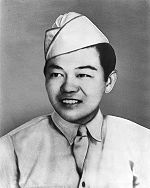
Private First Class Sadao S. Munemori 1922 – 1945


Sadao S. Munemori born August 17, 1922 – April 5, 1945, was a posthumous recipient of the Medal of Honor, after he sacrificed his life to save those of his colleagues at Seravezza, Italy during the closing stages of World War II. Munemori was a private first class in the United States Army, in Company A, 100th Infantry Battalion, 442nd Regimental Combat Team.
Munemori was born in Los Angeles, California. In 1942, shortly after he volunteered for the U.S. Army, Munemori's parents and siblings were incarcerated at the Manzanar internment camp for Japanese Americans.

Medal of Honor Citation

100th Infantry Battalion, 442d Combat Team. Place and date: Near Seravezza, Italy, 5 April 1945. Entered service at: Los Angeles, Calif Birth: Los Angeles, Calif. G.O. No.. 24, 7 March 1946. Citation: He fought with great gallantry and intrepidity near Seravezza, Italy. When his unit was pinned down by grazing fire from the enemy's strong mountain defense and command of the squad devolved on him with the wounding of its regular leader, he made frontal, l-man attacks through direct fire and knocked out 2 machineguns with grenades Withdrawing under murderous fire and showers of grenades from other enemy emplacements, he had nearly reached a shell crater occupied by 2 of his men when an unexploded grenade bounced on his helmet and rolled toward his helpless comrades. He arose into the withering fire, dived for the missile and smothered its blast with his body. By his swift, supremely heroic action Pfc. Munemori saved 2 of his men at the cost of his own life and did much to clear the path for his company's victorious advance.

Sunday, May 30, 2010

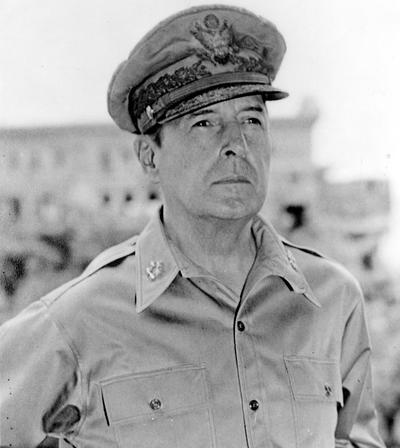
Duty, Honor, Country by General Douglas MacArthur


speech to the Corps of Cadets
at the U.S. Military Academy at West Point, N.Y., May 12, 1962,
in accepting the Thayer Award.a
General Westmoreland, General Groves, distinguished guests, and gentlemen of the Corps,

As I was leaving the hotel this morning, a doorman asked me, "Where are you bound for, General?" and when I replied, "West Point," he remarked, "Beautiful place: have you ever been there before?" [Laughter]b


No human being could fail to be deeply moved by such a tribute as this, coming from a profession I have served so long and a people I have loved so well. It fills me with an emotion I cannot express. But this award is not intended primarily to honorº a personality, but to symbolize a great moral code — the code of conduct and chivalry of those who guard this beloved land of culture and ancient descent. That is the animation of this medallion. For all eyes and for all time, it is an expression of the ethics of the American soldier. That I should be integrated in this way with so noble an ideal, arouses a sense of pride and yet of humility which will be with me always.

"Duty, Honor, Country" — those three hallowed words reverently dictate what you ought to be, what you can be, what you will be. They are your rallying point to build courage when courage seems to fail, to regain faith when there seems to be little cause for faith, to create hope when hope becomes forlorn.

Unhappily, I possess neither that eloquence of diction, that poetry of imagination, nor that brilliance of metaphor to tell you all that they mean.

The unbelievers will say they are but words, but a slogan, but a flamboyant phrase. Every pedant, every demagogue, every cynic, every hypocrite, every troublemaker, and, I am sorry to say, some others of an entirely different character, will try to downgrade them even to the extent of mockery and ridicule.

But these are some of the things they do.º They build your basic character. They mold you for your future roles as the custodians of the nation's defense. They make you strong enough to know when you are weak, and brave enough to face yourself when you are afraid.

They teach you to be proud and unbending in honest failure, but humble and gentle in success; not to substitute words for action; not to seek the path of comfort, but to face the stress and spur of difficulty and challenge; to learn to stand up in the storm, but to have compassion on those who fall; to master yourself before you seek to master others; to have a heart that is clean, a goal that is high; to learn to laugh, yet never forget how to weep; to reach into the future, yet never neglect the past; to be serious, yet never take yourself too seriously; to be modest so that you will remember the simplicity of true greatness, the open mind of true wisdom, the meekness of true strength.

They give you a temper of the will,º a quality of theº imagination, a vigor of the emotions, a freshness of the deep springs of life, a temperamental predominance of courage over timidity, an appetite for adventure over love of ease.

They create in your heart the sense of wonder, the unfailing hope of what next, and the joy and inspiration of life. They teach you in this way to be an officer and a gentleman.

And what sort of soldiers are those you are to lead? Are they reliable? Are they brave? Are they capable of victory?

Their story is known to all of you. It is the story of the American man at arms. My estimate of him was formed on the battlefieldº many, many years ago, and has never changed. I regarded him then, as I regard him now, as one of the world's noblest figures; not only as one of the finest military characters, but also as one of the most stainless.

His name and fame are the birthright of every American citizen. In his youth and strength, his love and loyalty, he gave all that mortality can give. He needs no eulogy from me, or from any other man. He has written his own history and written it in red on his enemy's breast.

But when I think of his patience under adversity, of his courage under fire, and of his modesty in victory, I am filled with an emotion of admiration I cannot put into words. He belongs to history as furnishing one of the greatest examples of successful patriotism. He belongs to posterity as the instructor of future generations in the principles of liberty and freedom. He belongs to the present, to us, by his virtues and by his achievements. º

In twenty campaigns, on a hundred battlefields, around a thousand campfires, I have witnessed that enduring fortitude, that patriotic self-abnegation, and that invincible determination which have carved his statue in the hearts of his people. From one end of the world to the other, he has drained deep the chalice of courage.

As I listened to those songs, in memory's eye I could see those staggering columns of the First World War, bending under soggy packs on many a weary march, from dripping dusk to drizzling dawn, slogging ankle-deep through theº mire of shell-pocked roads, to form grimly for the attack, blue-lipped, covered with sludge and mud, chilled by the wind and rain, driving home to their objective, and for many, to the judgment seat of God.

I do not know the dignity of their birth, but I do know the glory of their death. They died unquestioning, uncomplaining, with faith in their hearts, and on their lips the hope that we would go on to victory.

Always for them: Duty, Honor, Country. Always their blood, and sweat, and tears, as we soughtº the way and the light and the truth.º And twenty years after, on the other side of the globe, againº the filth of dirty foxholes, the stench of ghostly trenches, the slime of dripping dugouts, those broilingº suns ofº relentless heat, those torrential rains of devastating storms, the loneliness and utter desolation of jungle trails, the bitterness of long separation of those they loved and cherished, the deadly pestilence of tropicalº disease, the horror of stricken areas of war.

Their resolute and determined defense, their swift and sure attack, their indomitable purpose, their complete and decisive victory — always victory, always through the bloody haze of their last reverberating shot, the vision of gaunt, ghastly men, reverently following your password of Duty, Honor, Country.

The code which those words perpetuate embraces the highest moral law and will stand the test of any ethics or philosophies ever promoted for the uplift of mankind. Its requirements are for the things that are right, and its restraints are from the things that are wrong. The soldier, above all other men, is required to practice the greatest act of religious training: sacrifice. In battle and in the face of danger and death, he disposes those divine attributes which his Maker gave when he created man in His own image. No physical courage and no brute instinct can take the place of the divine help which alone can sustain him. However hard the incidents of war may be, the soldier who is called upon to offer and to give his life for his country is the noblest development of mankind. º

You now face a new world, a world of change. The thrust into outer space of the satellite spheres and missiles markº a beginning of another epoch in the long story of mankind.º In the five or more billions of years the scientists tell us it has taken to form the earth, in the three or more billion years of development of the human race, there has never been a more abrupt or staggering evolution. We deal now, not with things of this world alone, but with the illimitable distances and asº yet unfathomed mysteries of the universe. We are reaching out for a new and boundless frontier. We speak in strange terms: of harnessing the cosmic energy; of making winds and tides work for us; of creating unheardº synthetic materials to supplement or even replace our old standard basics; to purifyº sea water for our drink; of mining the ocean floors for new fields of wealth and food; of disease preventatives to expand life into the hundreds of years; of controlling the weather for a more equitable distribution of heat and cold, of rain and shine; of spaceships to the Moon;º of the primary target in war, no longer limited to the armed forces of an enemy, but instead to include his civil populations;ºd of ultimate conflict between a united human race and the sinister forces of some other planetary galaxy; ofº such dreams and fantasies as to make life the most exciting of all time.º

And through all this welter of change and development your mission remains fixed, determined, inviolable. It is to win our wars. Everything else in your professional career is but corollary to this vital dedication. All other public purposes,º all other public projects, all other public needs, great or small, will find others for their accomplishment;º but you are the ones who are trained to fight. Yours is the profession of arms, the will to win, the sure knowledge that in war there is no substitute for victory, that if you lose, the Nation will be destroyed, that the very obsession of your public service must be Duty, Honor, Country.

Others will debate the controversial issues, national and international, which divide men's minds. But serene, calm, aloof, you stand as the Nation's war guardians, as its lifeguards from the raging tides of international conflict, as its gladiators in the arena of battle. For a century and a half you have defended, guarded and protected its hallowed traditions of liberty and freedom, of right and justice. Let civilian voices argue the merits or demerits of our processes of government: whether our strength is being sapped by deficit financing indulged in too long, by federal paternalism grown too mighty, by power groups grown too arrogant, by politics grown too corrupt, by crime grown too rampant, by morals grown too low, by taxes grown too high, by extremists grown too violent; whether our personal liberties are as firm and complete as they should be; these great national problems are not for your professional participation or military solution. Your guidepost stands out like a tenfold beacon in the night: Duty, Honor, Country.

You are the leaven which binds together the entire fabric of our national system of defense. From your ranks come the great captains who hold the Nation's destiny in their hands the moment the war tocsin sounds.

The Long Gray Line has never failed us. Were you to do so, a million ghosts in olive drab, in brown khaki, in blue and gray,º would rise from their white crosses, thundering those magic words: Duty, Honor, Country.

This does not mean that you are warmongers. On the contrary, the soldier above all other people prays for peace, for he must suffer and bear the deepest wounds and scars of war. But always in our ears ring the ominous words of Plato, that wisest of all philosophers: "Only the dead have seen the end of war."c

The shadows are lengthening for me. The twilight is here. My days of old have vanished — tone and tint. They have gone glimmering through the dreams of things that were. Their memory is one of wondrous beauty, watered by tears and coaxed and caressed by the smiles of yesterday. I listen then, but with thirsty ear, for the witching melody of faint bugles blowing reveille, of far drums beating the long roll. In my dreams I hear again the crash of guns, the rattle of musketry, the strange, mournful mutter of the battlefield. But in the evening of my memory alwaysº I come back to West Point. Always there echoes and re-echoes: Duty, Honor, Country.

Today marks my final roll call with you. But I want you to know that when I cross the river, my last conscious thoughts will be of the Corps, and the Corps, and the Corps.

I bid you farewell.

Thursday, May 27, 2010

To The People of Texas and All Americans In The World by Col. William Barret Travis


--
February 24, 1836

Fellow citizens & compatriots --
I am beseiged, by a thousand or more of the Mexicans under Santa Anna -- I have sustained a continual Bombardment & cannonade for 24 hours & have not lost a man -- The enemy has demanded a surrender at discretion, otherwise, the garrison are to be put to the sword, if the fort is taken -- I have answered the demand with a cannon shot, & our flag still waves proudly from the walls -- I shall never surrender or retreat. Then, I call on you in the name of Liberty, of patriotism, & every thing dear to the American character, to come to our aid, with all dispatch -- The enemy is receiving reinforcements daily & will no doubt increase to three or four thousand in four or five days. If this call is neglected, I am determined to sustain myself as long as possible & die like a soldier who never forgets what is due to his own honor & that of his country --

VICTORY OR DEATH

William Barret Travis
Lt. Col. Comdt.

Sunday, May 23, 2010

Gen. Patton Speech; 3rd Army Speech


England; 31 MAY 1944 - 6th Armored Division


Now I want you to remember that no bastard ever won a war by dying for his country. You won it by making the other poor dumb bastard die for his country. Men, all this stuff you've heard about America not wanting to fight, wanting to stay out of the war, is a lot of horse dung. Americans traditionally love to fight. All real Americans, love the sting of battle. When you were kids, you all admired the champion marble shooter, the fastest runner, the big league ball players, the toughest boxers ... Americans love a winner and will not tolerate a loser. Americans play to win all the time. I wouldn't give a hoot in Hell for a man who lost and laughed. That's why Americans have never lost and will never lose a war. Because the very thought of losing is hateful to Americans. Now, an army is a team. It lives, eats, sleeps, fights as a team. This individuality stuff is a bunch of crap. The Bilious bastards who wrote that stuff about individuality for the Saturday Evening Post, don't know anything more about real battle than they do about fornicating. Now we have the finest food and equipment, the best spirit, and the best men in the world. You know ... My God, I actually pity those poor bastards we're going up against. My God, I do. We're not just going to shoot the bastards, we're going to cut out their living guts and use them to grease the treads of our tanks. We're going to murder those lousy Hun bastards by the bushel. Now some of you boys, I know, are wondering whether or not you'll chicken out under fire. Don't worry about it. I can assure you that you'll all do your duty. The Nazis are the enemy. Wade into them. Spill their blood, shoot them in the belly. When you put your hand into a bunch of goo, that a moment before was your best friends face, you'll know what to do. Now there's another thing I want you to remember. I don't want to get any messages saying that we are holding our position. We're not holding anything, we'll let the Hun do that. We are advancing constantly, and we're not interested in holding onto anything except the enemy. We're going to hold onto him by the nose, and we're going to kick him in the ass. We're going to kick the hell out of him all the time, and we're going to go through him like crap through a goose. Now, there's one thing that you men will be able to say when you get back home, and you may thank God for it. Thirty years from now when you're sitting around your fireside with your grandson on your knee, and he asks you, What did you do in the great World War Two? You won't have to say, Well, I shoveled shit in Louisiana. Alright now, you sons of bitches, you know how I feel. I will be proud to lead you wonderful guys into battle anytime, anywhere. That's all.