Showing posts with label Soldier. Show all posts

Monday, August 23, 2010

Sergeant Alvin Cullum York 1887 – 1964


Alvin Cullum York (December 13, 1887 – September 2, 1964) was the most decorated American soldier in World War I. He received the Medal of Honor for leading an attack on a German machine gun nest, taking 32 machine guns, killing 28 German soldiers and capturing 132 others. This action occurred during the U.S.-led portion of the Meuse-Argonne Offensive in France, which was part of a broader Allied offensive masterminded by Marshal Ferdinand Foch to breach the Hindenburg line and ultimately force the opposing German forces to capitulate.

Alvin Cullum York was born in a two-room log cabin near Pall Mall, Tennessee, on December 13, 1887, the third of eleven children born to Mary Elizabeth Brooks (8 August 1866 - 21 May 1943) and William Uriah York (15 May 1863 – 17 November 1911). William Uriah York was born in Jamestown, Tennessee, to Uriah York and Eliza Jane Livingston, both travelers from Buncombe County, North Carolina. Mary Elizabeth York was born in Pall Mall, Tennessee, to William Brooks and Nancy Pile, and was the great-granddaughter of Coonrod Pile, an English settler who settled Pall Mall in Tennessee. William York and Mary Brooks married on December 25, 1881, and had eleven children. The York siblings are, in order: Henry Singleton, Joseph Marion, Alvin Cullum, Samuel John, Albert, Hattie, George Alexander, James Preston, Lillian Mae, Robert Daniel, and Lucy Erma. The York family is of English, Irish, Choctaw, and Cherokee ancestry.

The York family resided in the Indian Creek area of Fentress County. The family was impoverished, with William York working as a blacksmith, by which he supplemented the family income. The father and sons of the York family would gather and harvest their own food, while the mother knitted all family clothing. The York sons only attended nine months of schooling, and withdrew from education because William York wanted his sons to assist him in tending to the family farm and hunting small game in order to feed the family.

When William York died in November 1911, his son Alvin assisted his mother in raising his younger siblings. Alvin was the oldest living sibling that was then-residing in the county, as his two older brothers had married and moved into more urban areas in the American South. In order to supplement the family income, York first held employment as a community laborer in Harriman, Tennessee, in which he assisted in the construction of a railroad and worked as a logger as well. By all accounts, he was a very skilled worker who was devoted to the welfare of his family. However, in the few years before the war, York was a violent alcoholic and prone to fighting in saloons, and had accumulated several arrests within the area. His mother, a member of a pacifist Protestant denomination, tried to persuade York to change his ways because she worried he would "amount to nothin'", however to no avail. In the winter of 1914, he and his friend engaged in a fight with other saloon patrons during a night of heavy drinking. The incident resulted in his friend Everett Delk being beaten to death inside a saloon in Clinton County, Kentucky. The event was profound enough that York finally followed his mother's advice and became a pacifist, and stopped drinking alcohol. York was baptized as a born again Christian in the Wolf River, with the baptism being conducted by Reverend H.H. Russell in early 1915.

In 1914, York joined the Church of Christ in Christian Union, a Protestant denomination, which had no specific doctrine of pacificism but opposed warfare and violence by all means. In a lecture later in life, he reported his reaction to the outbreak of World War I: "I was worried clean through. I didn't want to go and kill. I believed in my bible." On June 5, 1917, at the age of 29, Alvin York registered for the draft as all men between 21 and 31 years of age did on that day. When he registered for the draft, he answered the question "Do you claim exemption from draft (specify grounds)?" by writing "Yes. Don't Want To Fight." When his initial claim for conscientious objector status was denied, he appealed.

In World War I, conscientious objector status did not exempt one from military duty. Such individuals could still be drafted and were given assignments that did not conflict with their anti-war principles. In November 1917, while York's application was considered, he was drafted and began his army service at Camp Gordon in Georgia. There, extensive conversations with Major George Buxton challenged his pacifism and its Biblical basis until York decided he could and would serve.

From the day he registered for the draft until he arrived back from the war on May 29, 1919, York kept a diary of his activities. In his diary, York wrote that he refused to sign documents provided by his pastor seeking a discharge from the Army on religious grounds. He refused to sign similar documents provided by his mother asserting a claim of exemption as the sole support of his mother and siblings. He disclaimed ever having been a conscientious objector.

York enlisted in the United States Army and served in Company G, 328th Infantry Regiment, 82nd Infantry Division at Camp Gordon, Georgia. Discussions of the Biblical stance on war with his company commander, Captain Edward Courtney Bullock Danforth (1894–1973) of Augusta, Georgia and his battalion commander, Major Gonzalo Edward Buxton (1880–1949) of Providence, Rhode Island, eventually convinced York that warfare could be justified.

During an attack by his battalion to secure German positions along the Decauville rail-line north of Chatel-Chehery, France, on October 8, 1918, York's actions earned him the Medal of Honor. He recalled: "The Germans got us, and they got us right smart. They just stopped us dead in our tracks. Their machine guns were up there on the heights overlooking us and well hidden, and we couldn’t tell for certain where the terrible heavy fire was coming from… And I'm telling you they were shooting straight. Our boys just went down like the long grass before the mowing machine at home. Our attack just faded out… And there we were, lying down, about halfway across [the valley] and those German machine guns and big shells getting us hard."

Four non-commissioned officers and thirteen privates under the command of Sergeant Bernard Early (which included York) were ordered to infiltrate behind the German lines to take out the machine guns. The group worked their way behind the Germans and overran the headquarters of a German unit, capturing a large group of German soldiers who were preparing a counter-attack against the U.S. troops. Early’s men were contending with the prisoners when machine gun fire suddenly peppered the area, killing six Americans: Corp. Murray Savage, and Pvts. Maryan E. Dymowski, Ralph E. Weiler, Fred Waring, William Wins and Walter E. Swanson, and wounding three others, Sgt. Early, Corp. William S. Cutting (AKA Otis B. Merrithew) and Pvt. Mario Muzzi. The fire came from German machine guns on the ridge, which turned their weapons on the U.S. soldiers. The loss of the nine put Corporal York in charge of the seven remaining U.S. soldiers, Privates Joseph Kornacki, Percy Beardsley, Feodor Sok, Thomas C. Johnson, Michael A. Saccina, Patrick Donohue and George W. Wills. As his men remained under cover, and guarding the prisoners, York worked his way into position to silence the German machine guns.

York recalled: "And those machine guns were spitting fire and cutting down the undergrowth all around me something awful. And the Germans were yelling orders. You never heard such a racket in all of your life. I didn't have time to dodge behind a tree or dive into the brush… As soon as the machine guns opened fire on me, I began to exchange shots with them. There were over thirty of them in continuous action, and all I could do was touch the Germans off just as fast as I could. I was sharp shooting… All the time I kept yelling at them to come down. I didn't want to kill any more than I had to. But it was they or I. And I was giving them the best I had."

York, at the hill where his actions earned him the Medal of Honor, three months after the end of World War I on February 7, 1919

During the assault, a group of eight German soldiers in a trench near York were ordered to charge him with fixed bayonets. York had fired all the rounds in his rifle, but drew out his pistol and shot all eight of the soldiers before they could reach him.

One of York’s prisoners, German First Lieutenant Paul Jürgen Vollmer (who spoke fluent English) of 1st Battalion, 120th Württemberg Landwehr Regiment, emptied his pistol trying to kill York while he was contending with the machine guns. Failing to injure York, and seeing his mounting losses, he offered to surrender the unit to York, who gladly accepted. By the end of the engagement, York and his seven men marched 132 German prisoners back to the American lines. His actions silenced the German machine guns and were responsible for enabling the 328th Infantry to renew its attack to capture the Decauville Railroad.

York was awarded the Distinguished Service Cross for his heroism, but this was upgraded to the Medal of Honor, which was presented to York by the commanding general of the American Expeditionary Force, General John J. Pershing. The French Republic awarded him the Croix de Guerre and Legion of Honor. Italy and Montenegro awarded him the Croce di Guerra and War Medal, respectively.

York was a corporal during the action. His promotion to sergeant was part of the honor for his valor. Of his deeds, York said to his division commander, General George B. Duncan, in 1919: "A higher power than man power guided and watched over me and told me what to do."

Awards: Medal of Honor, Distinguished Service Cross, World War I Victory Medal, American Campaign Medal, World War II Victory Medal, French Légion d'honneur, French Croix de guerre with Palm, Italian Croce di Guerra, Montenegrin War Medal

On June 7, 1919, Alvin C. York and Gracie Loretta Williams (February 7, 1900 - September 27, 1984) were married by Tennessee Governor Albert H. Roberts in Pall Mall. They had seven children, all named after American historical figures: five sons (Alvin Cullum, Jr., Edward Buxton, Woodrow Wilson, Andrew Jackson, and Thomas Jefferson) and two daughters (Betsy Ross and Mary Alice).

York founded the Alvin C. York Agricultural Institute, a private agricultural school in Jamestown, Tennessee, that was eventually turned over to the State of Tennessee. The school, now known as Alvin C. York Institute, is the only fully state-funded public high school in the State of Tennessee. The school is a nationally recognized school of excellence and boasts the highest high school graduation percentage in the state. It is home to almost 800 students.

York also opened a Bible school and later operated a mill in Pall Mall on the Wolf River.

Alvin York died at the Veterans Hospital in Nashville, Tennessee, on September 2, 1964, of a cerebral hemorrhage and was buried at the Wolf River Cemetery in Pall Mall. His funeral sermon was delivered by Richard G. Humble, General Superintendent of the Churches of Christ in Christian Union. Humble also preached Mrs. York's funeral in 1984.

York's son, Thomas Jefferson York, was killed in the line of duty on May 7, 1972 while serving as a constable in Tennessee.

Medal of Honor Citation
Rank and organization: Corporal, U.S. Army, Company G, 328th Infantry, 82d Division. Place and date: Near Chatel-Chehery, France, 8 October 1918. Entered service at: Pall Mall, Tenn. Born: 13 December 1887, Fentress County, Tenn. G.O. No.: 59, W.D., 1919. Citation: After his platoon had suffered heavy casualties and 3 other noncommissioned officers had become casualties, Cpl. York assumed command. Fearlessly leading 7 men, he charged with great daring a machinegun nest which was pouring deadly and incessant fire upon his platoon. In this heroic feat the machinegun nest was taken, together with 4 officers and 128 men and several guns.

Wednesday, August 4, 2010

Sergeant First Class Randall 'Randy' David Shughart 1958 – 1993


Sergeant First Class Randall 'Randy' David Shughart (August 13, 1958–October 3, 1993) was a soldier in the United States Army special operations unit, the 1st Special Forces Operational Detachment-Delta (1SFOD-D), or "Delta Force." Shughart posthumously received the Medal of Honor for his actions during the Battle of Mogadishu in October 1993.

Randy Shughart was born on August 13, 1958 in Lincoln, Nebraska into an Air Force family. His father, Herbert Shughart, was stationed nearby. The Shugharts moved to Newville, Pennsylvania after Herb left the Air Force, living on and tending a dairy farm. Randy joined the Army while attending Big Spring High School in Newville, entering upon graduation. After basic training, he successfully completed AIT (advanced individual training), Airborne School, and afterwards was assigned to the 2nd Ranger Battalion, 75th Infantry (Airborne), at Fort Lewis, Washington. Several months later he completed a pre-ranger course (currently known as RIP, or Ranger Indoctrination Program), was granted a slot to attend Ranger School, graduated, and therefore earned the Ranger Tab. After leaving the service, then again reenlisting into the Rangers, Shughart was later assigned to "Delta Force" and was transferred to Fort Bragg, North Carolina.

Shughart was deployed to Mogadishu, Somalia with other Delta members in the summer of 1993 as part of Task Force Ranger. On October 3, 1993 Shughart was Sniper Team Leader during Operation Gothic Serpent, a joint-force assault mission to apprehend key advisers to Somali warlord Mohamed Farrah Aidid. During the assault, Super Six One, one of the Army's Black Hawk helicopters providing insertion and air support to the assault team, was shot down and had crashed in the city. A Combat Search and Rescue (CSAR) team was dispatched to the first crash site to secure it. Shortly thereafter, Super Six Four was shot down as well. Ranger forces on the ground were not able to assist the downed helicopter crew of the second crash site as they were already engaged in heavy combat with Aidid's militia and making their way to the first crash site.

Shughart and his Delta sniper teammates Gary Gordon and Sergeant First Class Brad Hallings had been providing sniper cover from the air. Gary Gordon requested to be inserted on the ground in order to secure the crash site and protect survivors, despite the fact that large numbers of armed, hostile Somalis were converging on the area.

Mission commanders denied Gordon's request twice, saying that the situation was already too dangerous for the three Delta snipers to effectively protect the Blackhawk crew from the ground. Command's position was that the snipers could be of more assistance by continuing to provide air cover. Gordon, however, concluded that there was no way the Black Hawk crew could survive on their own, and repeated his request twice until he finally received permission. Sergeant First Class Brad Hallings, who had assumed control of a minigun after a crew chief was injured, remained on the helicopter to provide cover from the air.

Gordon and Shughart were inserted approximately 100m from the crash site, armed with only their sniper rifles and sidearms, and made their way to the location of the downed Blackhawk. Chief Warrant Officer Mike Durant was already engaged in defending the downed aircraft with an MP5 but was unable to move from his pilot chair due to a crushed vertebrae in his back and a compound fracture of his left femur. When Gordon and Shughart reached Super Six Four, they extracted Durrant and the other crew members from the aircraft and established defensive positions around the crash.

It is believed that Gordon was first to be shot by the mob, which had surrounded the crash site. His teammate Shughart retrieved Gordon's CAR-15 assault rifle and gave it to Durant to use. Shortly after, Shughart was killed, the site was overrun and Durant was beaten by the mob before being taken hostage. Immediately after the firefight, the Somalis counted 24 of their own men dead with many more severely wounded who may have died later of their wounds.

There was some confusion in the aftermath of the action as to who had been killed first. The official citation states that it was Shughart, but author Mark Bowden, author of Black Hawk Down: A Story of Modern War, the best-selling book about the October 1993 events, relates an account by Sergeant Paul Howe, another Delta operator participating in the battle. Howe said that he heard Shughart call for help on the radio and that the weapon handed to Durant was not the distinctive M14 used by Shughart. Furthermore, Howe said that Shughart would never have given his own weapon to another soldier to use while he was still able to fight.

In Durant's book, In the Company of Heroes, he states that Gordon was on the left side of the Blackhawk, after both he and Shughart moved Durant to a safer location, and only heard Gordon say, "Damn, I'm hit." Afterwards Shughart came from the left side of the Blackhawk with the CAR-15.

Shughart is buried in Westminster Cemetery, Carlisle, PA.

Medal of Honor citation
Rank and organization: Sergeant First Class, U.S. Army. Place and date: 3 October 1993, Mogadishu, Somalia. Entered service at: ----- Born: Newville, Pennsylvania. Citation: Sergeant First Class Shughart, United States Army, distinguished himself by actions above and beyond the call of duty on 3 October 1993, while serving as a Sniper Team Member, United States Army Special Operations Command with Task Force Ranger in Mogadishu, Somalia. Sergeant First Class Shughart provided precision sniper fires from the lead helicopter during an assault on a building and at two helicopter crash sites, while subjected to intense automatic weapons and rocket propelled grenade fires. While providing critical suppressive fires at the second crash site, Sergeant First Class Shughart and his team leader learned that ground forces were not immediately available to secure the site. Sergeant First Class Shughart and his team leader unhesitatingly volunteered to be inserted to protect the four critically wounded personnel, despite being well aware of the growing number of enemy personnel closing in on the site. After their third request to be inserted, Sergeant First Class Shughart and his team leader received permission to perform this volunteer mission. When debris and enemy ground fires at the site caused them to abort the first attempt, Sergeant First Class Shughart and his team leader were inserted one hundred meters south of the crash site. Equipped with only his sniper rifle and a pistol, Sergeant First Class Shughart and his team leader, while under intense small arms fire from the enemy, fought their way through a dense maze of shanties and shacks to reach the critically injured crew members. Sergeant First Class Shughart pulled the pilot and the other crew members from the aircraft, establishing a perimeter which placed him and his fellow sniper in the most vulnerable position. Sergeant First Class Shughart used his long range rifle and side arm to kill an undetermined number of attackers while traveling the perimeter, protecting the downed crew. Sergeant First Class Shughart continued his protective fire until he depleted his ammunition and was fatally wounded. His actions saved the pilot's life. Sergeant First Class Shughart's extraordinary heroism and devotion to duty were in keeping with the highest standards of military service and reflect great credit upon him, his unit and the United States Army.

Tuesday, August 3, 2010

Master Sergeant Gary Ivan Gordon 1960 – 1993


Gary Gordon was born August 30, 1960 in Lincoln, Maine and graduated from Mattanawcook Academy in 1978. He joined the U.S. Army that same year at age 18 and after serving with the 2nd Battalion of the 10th Special Forces Group he was chosen to join the 1st Special Forces Operational Detachment-Delta (1SFOD-D), or "Delta Force" as a sniper. Before deploying with his unit to Somalia he married his wife Carmen and together they had two children.

Gordon was deployed to Mogadishu, Somalia with other Delta members in the summer of 1993 as part of Task Force Ranger. On October 3, 1993 Gordon was Sniper Team Leader during Operation Gothic Serpent, a joint-force assault mission to apprehend key advisers to Somali warlord Mohamed Farrah Aidid. During the assault, Super Six One, one of the Army's Black Hawk helicopters providing insertion and air support to the assault team, was shot down and crashed in the city. A Combat Search and Rescue team was dispatched to the first crash site to secure it and a short time later Super Six Four was shot down as well. Ranger forces on the ground were not able to assist the downed helicopter crew of the second crash site as they were already engaged in heavy combat with Aidid's militia and making their way to the first crash site.
Gordon and his Delta Force sniper teammates Sergeant First Class Randall Shughart and Sergeant First Class Brad Hallings, who were providing sniper cover from the air, wanted to be dropped at the second crash site in order to protect the four critically wounded crew, despite the fact that large numbers of armed, hostile Somalis were converging on the area. Mission commanders denied Gordon's request, saying that the situation was already too dangerous for the three Delta snipers to effectively protect the Blackhawk crew from the ground. Command's position was that the snipers could be of more assistance by continuing to provide air cover. Gordon, however, concluded that there was no way the Black Hawk crew could survive on their own, and repeated his request twice until he finally received permission. Sergeant First Class Brad Hallings had assumed control of a minigun after a crew chief was injured and was not inserted with Shughart and Gordon.

Once on the ground, Gordon and Shughart, armed with only their personal weapons and sidearms, fought their way to the downed Blackhawk. By this time more Somalis were arriving who were intent on either capturing or killing the American servicemen. When they reached Super Six Four, Gordon and Shughart extracted the pilot, Chief Warrant Officer Mike Durant and the other crew members from the aircraft, and established defensive positions around the crash. Despite having inflicted heavy casualties against the Somalis, the two Delta snipers were too outnumbered and outgunned. Their ammunition nearly depleted, Gordon and Shughart finally were killed by Somali gunfire. It is believed that Gordon was first to be fatally wounded. His teammate Shughart retrieved Gordon's CAR-15 assault rifle and gave it to Durant to use. Shortly after, Shughart was killed and Durant was taken alive. Immediately after the battle, the Somalis counted 24 of their own men dead with many more severely wounded who may have died later of their wounds.

He died there in Somalia October 3, 1993 and is buried in Lincoln Cemetery, Penobscot County, Maine.

There was some confusion in the aftermath of the action as to who had been killed first. The official citation states that it was Shughart, but author Mark Bowden, author of Black Hawk Down: A Story of Modern War, the book about the October 1993 events, relates an account by Sergeant Paul Howe, another Delta operator participating in the battle. Howe said that he heard Shughart call for help on the radio and that the weapon handed to Durant was not the distinctive M14 used by Shughart. Furthermore, Howe said that Shughart would never have given his own weapon to another soldier to use while he was still able to fight. In Durant's book, In the Company of Heroes, he states that Gordon was on the left side of the Blackhawk, after both he and Shughart moved Durant to a safer location, and only heard Gordon say, "Damn, I'm hit." Afterwards Shughart came from the left side of the Blackhawk with the CAR-15.

After the attack on the United States on September 11, 2001, United States Special Forces units were inserted into Afghanistan to assist the Northern Alliance forces in overthrowing the Taliban and Al-Qaeda terrorists. Following an intense mountain battle known as Operation Anaconda in March 2002, U.S. troops searching a bunker complex found a GPS unit and holding pouch labeled "G. Gordon". Intelligence analysts believed at first this was Sergeant Gordon's GPS unit that he purchased on the private market and used in Somalia. The Gordon family was notified immediately of the find prior to the information being released to the public. It ultimately turned out that it wasn't Gordon's GPS but one of a helicopter pilot lost in an earlier fight during Operation Anaconda.

MSG Gordon's personal decorations include:
During his military career he earned the following military decorations: Medal of Honor, Purple Heart, Meritorious Service Medal, Army Commendation Medal, Joint Service Achievement Medals (x2), Good Conduct Medal (x4), Combat Infantryman Badge, Master Parachutist Badge, Ranger Tab, Special Forces Tab, French Army Mountaineering Badge, the Royal Danish Parachutist Badge and the Joint Meritorious Unit Award.

Medal of Honor Citation

Rank and organization: Master Sergeant, U.S. Army. Place and date: 3 October 1993, Mogadishu, Somalia. Entered service at: ----- Born: Lincoln, Maine. Citation: Master Sergeant Gordon, United States Army, distinguished himself by actions above and beyond the call of duty on 3 October 1993, while serving as Sniper Team Leader, United States Army Special Operations Command with Task Force Ranger in Mogadishu, Somalia. Master Sergeant Gordon's sniper team provided precision fires from the lead helicopter during an assault and at two helicopter crash sites, while subjected to intense automatic weapons and rocket propelled grenade fires. When Master Sergeant Gordon learned that ground forces were not immediately available to secure the second crash site, he and another sniper unhesitatingly volunteered to be inserted to protect the four critically wounded personnel, despite being well aware of the growing number of enemy personnel closing in on the site. After his third request to be inserted, Master Sergeant Gordon received permission to perform his volunteer mission. When debris and enemy ground fires at the site caused them to abort the first attempt, Master Sergeant Gordon was inserted one hundred meters south of the crash site. Equipped with only his sniper rifle and a pistol, Master Sergeant Gordon and his fellow sniper, while under intense small arms fire from the enemy, fought their way through a dense maze of shanties and shacks to reach the critically injured crew members. Master Sergeant Gordon immediately pulled the pilot and the other crew members from the aircraft, establishing a perimeter which placed him and his fellow sniper in the most vulnerable position. Master Sergeant Gordon used his long range rifle and side arm to kill an undetermined number of attackers until he depleted his ammunition. Master Sergeant Gordon then went back to the wreckage, recovering some of the crew's weapons and ammunition. Despite the fact that he was critically low on ammunition, he provided some of it to the dazed pilot and then radioed for help. Master Sergeant Gordon continued to travel the perimeter, protecting the downed crew. After his team member was fatally wounded and his own rifle ammunition exhausted, Master Sergeant Gordon returned to the wreckage, recovering a rifle with the last five rounds of ammunition and gave it to the pilot with the words, "good luck." Then, armed only with his pistol, Master Sergeant Gordon continued to fight until he was fatally wounded. His actions saved the pilot's life. Master Sergeant Gordon's extraordinary heroism and devotion to duty were in keeping with the highest standards of military service and reflect great credit upon him, his unit and the United States Army.

Friday, June 25, 2010

Sergeant First Class PAUL R. SMITH 1969 - 2003


Paul Ray Smith (September 24, 1969 – April 4, 2003) was a United States Army Sergeant First Class who posthumously received the Medal of Honor for his actions in Operation Iraqi Freedom. While serving with B Company, 11th Engineer Battalion, 3rd Infantry Division in Baghdad, Iraq his team was attacked by a group of enemy fighters and after a short firefight he was killed by enemy fire. For his actions during this battle he was recommended and approved for the Medal of Honor. Two years later the medal, along with the newly approved Medal of Honor flag, was presented to his family at a White House ceremony by the President of the United States George W. Bush.
Smith was born September 24, 1969 in El Paso, Texas to Donald and Janice Pvirre but when he was nine the family moved to Tampa, Florida. As a child he attended public schools and enjoyed sports especially American football. He also liked riding skateboards and bicycles, playing pranks with his friends and younger sister Lisa. In high school he became interested in carpentry, even finding a part time job as a carpenters assistant. He also liked to work on cars, especially old ones and enjoyed taking things apart to see how they worked, even restoring a dune buggy with a friend. In 1989 he graduated from Tampa Bay Vocational Tech High School and shortly after joined the United States Army in October 1989.
He was sent to Basic Training at Fort Leonard Wood, Missouri before being sent to Germany for his first duty station, where he joined the 9th Engineer Battalion. Later, he served during the Persian Gulf War. He deployed with B company in October 1996 as part of the 2nd Brigade Combat Team, the covering force for Operation Joint Endeavor and Operation Joint Guardian; the battalion returned to Schweinfurt in April 1997. In 1999 he was posted to the 11th Engineer Battalion and deployed with them to Kosovo in May 2001, were he was responsible for daily presence patrols in the town of Gnjilane. In the spring of 2002, he received a promotion to Sergeant First Class and completed the Advanced Non-Commissioned Officer Course in August 2002.
As part of the 2003 invasion of Iraq, he was assigned to B Company, 11th Engineer Battalion of the 3rd Infantry Division. His company was supporting the 2nd Battalion, 7th Infantry Regiment as it made its way through the Karbala Gap, across the Euphrates River and to Saddam International Airport (BIAP) in Baghdad. On April 4, 2003, a 100-man force was assigned to block the highway between Baghdad and the airport, about one mile east of the airport. After a brief battle, several of the enemy were captured. Smith spotted a walled enclosure nearby with a tower overlooking it. He and his squad set about building an impromptu enemy prisoner of war (EPW) holding area in the enclosure. Smith and 16 other men used an Armored Combat Earthmover (similar to a bulldozer) to knock a hole in the south wall of the courtyard. On the north side, there was a metal gate that Smith assigned several men to guard. These men noticed 50–100 enemy who had taken positions in trenches just past the gate. He summoned a Bradley fighting vehicle to attack their position. Three nearby M113 Armored Personnel Carriers came to support the attack. An M113 was hit, possibly by a mortar, and all three crewmen were wounded. The Bradley, damaged and running low on ammunition, withdrew to reload during a lull in the battle. Smith organized the evacuation of the injured M113 crewmen. However, behind the courtyard was a military aid station crowded with 100 combat casualties. To protect it from being overrun, Smith chose to fight on rather than withdraw with the wounded.
Meanwhile, some enemy had taken position in the tower overlooking the courtyard, just over the west wall. The enemy now had the Americans in the courtyard under an intense crossfire. Smith took command of the M113 and ordered a driver to position it so that he could attack both the tower and the trenches. He manned the M113's machine gun, going through three boxes of ammunition. A separate team, led by First Sergeant Tim Campbell attacked the tower from the rear, killing the enemy. As the battle ended, Smith's machine gun fell silent. His comrades found him slumped in the turret hatch. His armored vest was peppered with 13 bullet holes, the vest's ceramic armor inserts, both front and back, cracked in numerous places. But the fatal shot, one of the last from the tower, had entered his neck and passed through his brain, killing SFC Smith.
Before deploying to Iraq Smith had written to his parents, "There are two ways to come home, stepping off the plane and being carried off the plane. It doesn't matter how I come home, because I am prepared to give all that I am to ensure that all my boys make it home." Smith is buried in Arlington National Cemetery Arlington, Virginia and his grave can be found in memorial Section D, lot 67.
At the time of his death he had served for thirteen years and for his actions during the battle, he was posthumously awarded the Medal of Honor. On April 4, 2005, exactly two years after he was killed, his eleven-year-old son David received the Medal of Honor from President George W. Bush along with the Medal of Honor flag.
SFC Smith is survived by his wife Birgit, son David, and stepdaughter Jessica.
During his military career he received twenty-two military decorations and badges. A full list of his military decorations are as follows: Medal of Honor, Bronze Star, Purple Heart, Army Commendation Medal, Army Achievement Medal, Good Conduct Medal (3rd award), National Defense Service Medal, Armed Forces Expeditionary Medal, Southwest Asia Service Medal(with three bronze stars), Global War on Terrorism Service Medal, Global War on Terrorism Expeditionary Medal, Army NCO Professional Development Ribbon (2nd award), Army Service Ribbon, Overseas Service Ribbon (3rd award), NATO Medal (Kosovo), Kuwait Liberation Medal (Saudi Arabia), Kuwait Liberation Medal (Kuwait), Valorous Unit Award, Army Superior Unit Award, German Marksmanship Badge and the French Armed Forces Commando Badge.
Medal Of Honor Citation
Rank and Organization: Sergeant First Class, United States Army
For conspicuous gallantry and intrepidity at the risk of his life above and beyond the call of duty:Sergeant First Class Paul R. Smith distinguished himself by acts of gallantry and intrepidity above and beyond the call of duty in action with an armed enemy near Baghdad International Airport, Baghdad, Iraq on 4 April 2003. On that day, Sergeant First Class Smith was engaged in the construction of a prisoner of war holding area when his Task Force was violently attacked by a company-sized enemy force. Realizing the vulnerability of over 100 fellow soldiers, Sergeant First Class Smith quickly organized a hasty defense consisting of two platoons of soldiers, one Bradley Fighting Vehicle and three armored personnel carriers. As the fight developed, Sergeant First Class Smith braved hostile enemy fire to personally engage the enemy with hand grenades and anti-tank weapons, and organized the evacuation of three wounded soldiers from an armored personnel carrier struck by a rocket propelled grenade and a 60mm mortar round. Fearing the enemy would overrun their defenses, Sergeant First Class Smith moved under withering enemy fire to man a .50 caliber machine gun mounted on a damaged armored personnel carrier. In total disregard for his own life, he maintained his exposed position in order to engage the attacking enemy force. During this action, he was mortally wounded. His courageous actions helped defeat the enemy attack, and resulted in as many as 50 enemy soldiers killed, while allowing the safe withdrawal of numerous wounded soldiers. Sergeant First Class Smith’s extraordinary heroism and uncommon valor are in keeping with the highest traditions of the military service and reflect great credit upon himself, the Third Infantry Division “Rock of the Marne,” and the United States Army.

Thursday, June 24, 2010

Private First Class ROSS A. McGINNIS 1987 - 2006


Ross Andrew McGinnis (June 14, 1987 – December 4, 2006) was a soldier who served in the United States Army during the Iraq War and was posthumously awarded the United States' highest decoration for bravery, the Medal of Honor. While serving as the gunner in a HMMWV, his convoy was attacked and a hand grenade was thrown into his vehicle. McGinnis was subsequently killed in action when he threw himself on the grenade, saving the lives of at least four other soldiers in the vehicle. He was the fourth soldier to receive the Medal of Honor during the Iraq War, which was presented to his family following his death.
McGinnis was born in Meadville, Pennsylvania on June 14, 1987 to Romayne and Tom McGinnis. Although he was born in Meadville he grew up in Knox, east of Pittsburgh, after his family moved there when he was three. When he was in kindergarten, his teacher gave him a paper that at the top said "When I grow up, I want to be __________" and he wrote an "Army Man". When he was growing up he became involved in the Boy Scouts of America, enjoyed working on cars, and was an athlete playing multiple sports. He played basketball and soccer through the YMCA, and Little League baseball. He attended Clarion County public schools and although he was a marginal student, he graduated from Keystone Junior/Senior High School in 2005. He has two sisters, Becky and Katie.
McGinnis had wanted to be a soldier since kindergarten and joined the Army through the Delayed Entry Program on his 17th birthday, on June 14, 2004. Following basic training at Fort Benning, Georgia, he was assigned to the 1st Battalion, 26th Infantry Regiment, in Ledward Barracks, in Schweinfurt, Germany.[4]
In August 2006, aged 19, the regiment was deployed to eastern Baghdad and he was serving as a .50 caliber machine-gunner in a Humvee during operations against insurgents in Adhamiyah. On December 4, while his platoon was on mounted patrol in Adhamiyah, a grenade was thrown into his vehicle. He told the other four men about it, so they could prepare for the blast. Instead of jumping out of the gunning hatch, he threw his back over the grenade, absorbing the bulk of the blast. He was killed instantly, but the other occupants were able to survive with only minor injuries.
He is buried at Arlington National Cemetery in Virginia and his grave can be found in section 60, site 8544. Since the beginning of the Iraq War, he is one of four known United States servicemembers who have thrown themselves on a live grenade. The other personnel known to have done this are Marine Corporal Jason Dunham, Navy SEAL Petty Officer 2nd Class Michael A. Monsoor, and Marine Sergeant Rafael Peralta. McGinnis was the fourth recipient of the Medal of Honor in the course of the Iraq War.
A ceremony was held in the east room of the White House on June 2, 2008 in which the medal was presented to his family by President George W. Bush. In addition to his family and the President a many other notable people attended the ceremony, including the Vice President, the Secretary of Veterans Affairs James Peake, Secretary of the Army Pete Geren, Secretary of the Air Force Michael Wynne, General Jim "Hoss" Cartwright, and the Vice Chairman of the Joint Chiefs. Several members of congress also attended as did members of McGinnis' unit from Iraq, including the other soldiers from the vehicle he sacrificed his life to save.
In addition to the Medal of Honor he also received a posthumous promotion to specialist as well as the following medals and ribbons; Silver Star, Bronze Star, Purple Heart, Army Good Conduct Medal, National Defense Service Medal, Iraq Campaign Medal, Global War on Terrorism Service Medal, Army Service Ribbon, and Army Overseas Service Ribbon.
Medal Of Honor Citation
Rank and Organization: Private First Class, United States Army
For conspicuous gallantry and intrepidity at the risk of his life above and beyond the call of duty:
Private First Class Ross A. McGinnis distinguished himself by acts of gallantry and intrepidity above and beyond the call of duty while serving as an M2 .50-caliber Machine Gunner, 1st Platoon, C Company, 1st Battalion, 26th Infantry Regiment, in connection with combat operations against an armed enemy in Adhamiyah, Northeast Baghdad, Iraq, on 4 December 2006.

That afternoon his platoon was conducting combat control operations in an effort to reduce and control sectarian violence in the area. While Private McGinnis was manning the M2 .50-caliber Machine Gun, a fragmentation grenade thrown by an insurgent fell through the gunner's hatch into the vehicle. Reacting quickly, he yelled "grenade," allowing all four members of his crew to prepare for the grenade's blast. Then, rather than leaping from the gunner's hatch to safety, Private McGinnis made the courageous decision to protect his crew. In a selfless act of bravery, in which he was mortally wounded, Private McGinnis covered the live grenade, pinning it between his body and the vehicle and absorbing most of the explosion.

Private McGinnis' gallant action directly saved four men from certain serious injury or death. Private First Class McGinnis' extraordinary heroism and selflessness at the cost of his own life, above and beyond the call of duty, are in keeping with the highest traditions of the military service and reflect great credit upon himself, his unit, and the United States Army.

SGT 1ST CLASS JARED C. MONTI 1975 - 2006


Sergeant First Class Jared Christopher Monti (September 20, 1975 – June 21, 2006) was a soldier in the United States Army who received the United States military's highest decoration for valor, the Medal of Honor, for his actions in Afghanistan. Monti was born in Abington, Massachusetts, on September 20, 1975, to Paul, a school teacher, and Janet Monti. He grew up in Raynham, Massachusetts and even as a child the adventurous character that would later earn him the Medal of Honor was already appeared. As a four-year-old, he disappeared from the backyard one day, and his mother found him later, hanging from his hood on the other side of the fence. On another occasion, a migraine headache kept him home from school, but he left the house and was later found climbing a tree. Monti became interested in bodybuilding and by the time he graduated had become a New England champion in wrestling. In 1994 he graduated from Bridgewater-Raynham Regional High School at the age of 18. Monti had two siblings, a sister, Niccole and a brother, Timothy.
Official Narrative
In June of 2006, the 3rd Squadron of the 71st Cavalry Regiment (Recon), 3rd Brigade Combat Team, 10th Mountain Division, prepared to execute Operation Gowardesh Thrust, a Squadron size operation in the Gremen Valley, Nuristan Province, Afghanistan.
The operation was designed to disrupt enemy operations in the Gremen Valley by denying the enemy freedom of movement and the use of critical staging areas near the border with Pakistan. The initial phase of the operation required a 16-man patrol to infiltrate into the area of operations in advance of the Squadron’s main effort.
The patrol, consisting of snipers, forward observers and scouts, would maneuver north along a high ridgeline overlooking the Gremen Valley. From the high ground of the ridge, the patrol would provide real-time intelligence and help direct fires against enemy forces attempting to oppose the Squadron’s main effort.
On the evening of June 17, 2006, a convoy transported the patrol to a pre-established mortar firing position south of the village of Baz-Gal near the Gowardesh Bridge. The following morning, the patrol infiltrated on foot from the mortar firing position into their area of operation. For three days, the patrol moved north up the ridgeline through rugged mountain terrain. Due to the difficulty of the climb and temperatures near 100 degrees, the patrol moved mostly at night or in the early morning hours; stopping during the heat of the day to observe the valley below.
On June 20, 2006, the patrol leaders, Staff Sgt. Christopher M. Cunningham and Staff Sgt. Jared C. Monti, halted the patrol on the ridgeline of Mountain 2610, approximately 5 kilometers northwest of the village of Gowardesh. With an elevation of over 2600 meters, Mountain 2610 commanded a view of several enemy known areas of interest, including insurgent safe houses and the summer residence of Hadji Usman, an HIG commander, who was a vetted Combined Joint Task Force 76 insurgent target.
Staff Sgt. Cunningham and Staff Sgt. Monti selected a flat area on top of the ridge approximately 50 meters long and 20 meters wide, with a trail running along the eastern edge. At the southern end of the position, there were several large rocks, a portion of an old stone wall and a few small trees. The terrain sloped gradually upward to the north. At the northern end of the patrol’s position there was a line of dense vegetation composed of trees, heavy brush and smaller rocks. In between the large rocks to the south and the tree line to the north was a clearing approximately 40-50 meters in length. The terrain dropped off steeply on the eastern and western sides of the position. The rocks and trees around the position provided concealment and protection for the patrol as they observed the valley more than 1,000 meters below.
The patrol spent the night of June 20, 2006, observing from their position on Mountain 2610. The following morning the patrol was dangerously low on both food and water. A re-supply mission was scheduled for that day. The re-supply was originally coordinated to occur in conjunction with the Squadron’s main effort, which included a large air assault into the Gremen Valley. The heavy helicopter traffic associated with the air assault mission would have provided distraction for the re-supply; reducing the risk that the drop would compromise the patrol’s position. However, on the morning of June 21, 2006, Monti and Cunningham learned that the Squadron operation had been pushed back until June 24, 2006. The delay extended the patrol’s mission by several days, making re-supply critical; however, the absence of other aerial traffic increased the risk that the re-supply would compromise the patrol. Because of the critical shortage of water, it was determined that the re-supply would go forward as planned despite the risk of compromise.
The drop zone was located approximately 150 meters from the patrol’s position. Staff Sgt. Cunningham and Staff Sgt. Monti brought the majority of their patrol to the re-supply drop zone to provide security and to transport the supplies back to the patrol’s position. A smaller group remained at the observation position to provide security and to continue to survey the valley below. At approximately 1:30 in the afternoon, a UH-60 Black Hawk delivered food and water to the patrol. The patrol secured the supplies and began transporting them back to their observation position.
Spc. Max Noble, the patrol’s medic, was one of the Soldiers who remained at the observation position while the majority of the patrol picked up the re-supply. Spc. Noble was using a spotting scope to look down into the valley. Prior to the patrol’s return from the re-supply drop, Noble observed a local national male in the valley using military style binoculars to look up towards at the patrol’s position. Spc. Noble informed Cunningham and Monti as soon as they returned. They watched the man observing the patrol’s position for several minutes before he picked up a bag and walked away.
As dusk approached, the patrol established a security perimeter around their position and scheduled guard rotations. The patrol members then divided up the supplies and prepared for the night. Staff Sgt. Cunningham, Staff Sgt. Monti, and Sgt. John R. Hawes sat behind one of the large rocks at the southern end of the patrol’s position and discussing courses of action in the event that their position had likely been compromised. Pfc. Brian J. Bradbury, Pfc. Mark James, Pvt. Sean J. Smith, Spc. Matthew P. Chambers, Spc. Shawn M. Heistand, and Spc. Franklin L. Woods were at the northern end of the position, near the wood line. Sgt. Chris J. Grzecki, Spc. Noble, and Spc. John H. Garner were along the trail on the eastern edge of the position using spotting scopes to monitor the valley below.
At approximately, 6:45 in the evening, Spc. Woods heard the shuffling of feet in the wood line immediately to the north. Before he could react, the patrol’s position was hit by a barrage of rocket-propelled grenades (RPGs), medium machine gun (PK) fire, and small-arms fire from the wood line. An enemy force of approximately 50 fighters was moving in under cover from two support-by-fire positions above the patrol to the north and northwest. Members of the patrol could hear enemy fighters giving commands as they moved through the wood line at the northern end of the patrol’s position.
At the time of the attack, the six patrol members at the northern end of the patrol’s position immediately dove for cover as the enemy opened fire. The attack came so quickly and with such ferocity, that many of the patrol members at the northern end of the position were unable to maneuver to get to their weapons. Others had their weapons literally shot out of their hands by the intense fire.
Spc. Heistand and Pfc. Bradbury were both near the wood line when the enemy opened fire. Heistand was armed with an assault rifle and Bradbury was a Squad Automatic Weapon (SAW) gunner. Both hit the ground and began to return fire. However, they soon realized that their fire was drawing the enemies’ attention to their dangerously exposed position in the open area near the wood line. Spc. Heistand told Pfc. Bradbury that they had to fall back to the south where the large rocks would provide better cover. Spc. Heistand then jumped up and sprinted back towards the large rocks at the southern end of the position. Pfc. Bradbury was directly behind Spc. Heistand as they headed for the rocks, however, Pfc. Bradbury did not make it back to the rocks.
Pfc. James, Spc. Chambers, Spc. Woods, and Pvt. Smith were also in the area near the wood line when the enemy attacked. They also fell quickly back towards the large rocks to the south. Chambers, Woods, and Smith successfully made it to cover without injury; however, Pfc. James was hit by small arms fire in the back and wrist as he ran for cover to the south. Although wounded, Pfc. James was able to crawl back towards the rest of the patrol on the southern end of the position. As soon as he was close enough, other members of the patrol grabbed James and drug him to better cover behind the rocks. Spc. Chambers, who lost his weapon in the initial volley, then took Pfc. James to a safe position further back from the rocks and administered first aid.
From behind the rocks at the southern end of the patrol’s position, Staff Sgt. Monti, Staff Sgt. Cunningham, and Sgt. Hawes returned fire, attempting to cover for the patrol members falling back from the north. However, the intensity of the enemy small arms fire and frequent volleys of RPGs made it dangerous for the patrol members to expose themselves in order to accurately aim their return fire.
Sgt. Patrick L. Lybert was in a prone position beside the small stone wall which was slightly out in front of the larger rocks at the southern end of the patrol’s position. Although his position did not provide complete cover, it did provide the best vantage to place accurate fire on the enemy. From his position, Sgt. Lybert used aimed shots and controlled bursts to effectively slow the approaching enemy while other members of the patrol consolidated their position behind the rocks at the southern end of the position.
As the patrol fell back behind the large rocks, Staff Sgt. Cunningham and Staff Sgt. Monti took charge of the defense. They quickly set up a perimeter, posting Soldiers to guard potential approaches on their flanks. They directed return fire and cautioned their Soldiers to control their fires to conserve ammunition. Staff Sgt. Monti grabbed his radio handset and cleared the network to call for fire. He calmly informed headquarters that the patrol was under attack, heavily outnumbered, and at risk of being overrun.
Staff Sgt. Monti provided accurate grid coordinates of the enemy’s current positions and likely avenues of approach as RPGs skipped off of the rock above his head. Due to the proximity of the enemy forces, Staff Sgt. Monti’s call for fire was ‘danger close.’
While Monti was calling in the fire support mission, Staff Sgt. Cunningham moved along the rocks towards the eastern edge of the patrol’s position to take charge of the defense at that end of the position. Sgt. Hawes remained on the western side of the position to defend the western approach and to provide cover for Monti as he worked the radio calling for indirect fire. Sgt. Lybert was still out in front of the larger rocks returning fire from behind the stone wall. At some point, members of the patrol saw Lybert’s head slump forward and blood began to pour from his ears. Members of the patrol called out to Sgt. Lybert, but he did not respond. Spc. Noble, the patrol’s medic was on the western side of the position, near Sgt. Lybert, but was unable to get to Lybert to provide treatment due to the volume of enemy fire. However, Spc. Daniel B. Linnihan crawled out just far enough to grab Sgt. Lybert’s weapon and drag it back behind the rocks for use by the members of the patrol.
The enemy used support by fire positions to fix the patrol as they split into two groups to flank the patrol from the east and west. One group of approximately 15 fighters moved through the wood line towards the patrol’s western flank while a smaller group maneuvered across the trail to attempt to flank the eastern side of the position. The patrol members on either end of the position redirected their fires to protect their flanks. Patrol members with weapons traded off with unarmed members to ensure that the Soldier in the best position had a weapon to defeat the flanking maneuver. Pvt. Smith was along the trail on the eastern edge of the patrol’s position. From a covered position he killed several enemy fighters attempting to move up the trail to flank the patrol.
While still communicating with the Squadron headquarters, Staff Sgt. Monti periodically dropped the handset to engage the enemy with his rifle. At one point, he noticed a group of fighters closing in on the western flank and disrupted their attack with several bursts from his M-4. As the enemy closed within ten meters of the patrol’s defensive perimeter, Monti threw a grenade into their path. Although the grenade was inert, it’s presence disrupted the enemy advance and caused them to scatter and fall back, denying the enemy a position on the patrol’s flank. Staff Sgt. Monti then went back to the radio and continued to call for fire.
At this time, the initial volley of mortar fire began to fall on the advancing enemy, driving them back to a wood line north of the patrol’s position. The mortar firing position asked Staff Sgt. Monti to adjust the incoming rounds, however, the enemy fire from the wood line was so extreme that Monti was unable to even raise his head up to observe the incoming rounds.
As the enemy was driven back into the wood line, Staff Sgt. Monti and Staff Sgt. Cunningham took accountability of their Soldiers. They quickly realized that one Soldier, Pfc. Bradbury, was unaccounted for. Monti called for Bradbury several times and received no response. Finally, over the din of near constant enemy fire, they heard Pfc. Bradbury weakly reply that he was badly injured and unable to move.
Pfc. Bradbury, who was a SAW gunner on Staff Sgt. Monti’s team, lay severely wounded in a shallow depression approximately 20 meters in front of the patrol. The shallow depression prevented the patrol from actually seeing Bradbury, but it also protected him from enemy view. Other than the shallow depression, there was no other substantial cover near the wounded Soldier. The enemy in the wood line was as close as 30 meters on the other side of Pfc. Bradbury.
Staff Sgt. Monti recognized that Pfc. Bradbury was not only exposed to enemy fire, but also to the incoming indirect fire. He called out to Bradbury to reassure him that he would be alright and that they were coming to get him. Staff Sgt. Cunningham yelled across the rocks to Monti, that he would go for Pfc. Bradbury. However, Monti insisted that Bradbury was his Soldier and that he would go and get him.
Staff Sgt. Monti then handed the radio handset to Sgt. Grzecki and said, “you are now Chaos three-five,” which was Monti’s call sign. After tightening down his chin strap, Staff Sgt. Monti, without hesitation or concern for his own safety, moved out from behind the protection of the large rocks into the open, and into the face of enemy fire.
The wood line immediately erupted as dozens of enemy fighters focused their fire on Staff Sgt. Monti running towards his wounded Soldier. Patrol members reported hearing the distinct report of PK machine guns as soon as Monti left the protection of the rocks. Moving low and fast, Monti approached to within a few meters of Bradbury before heavy enemy fire forced him to move back and dive behind the small stone wall where Sgt. Lybert was located.
After pausing briefly to verify that Sgt. Lybert was dead, Staff Sgt. Monti again rose from his covered position and again moved out into a wall of enemy fire in his second attempt to save Pfc. Bradbury. This time, the fire was even more intense and Monti only made it a few steps before a volley of small arms fire and RPGs drove him back behind cover of the stone wall.
Unwilling to leave his Soldier wounded and exposed, Staff Sgt. Monti prepared to make a third attempt to get to the wounded Pfc. Bradbury. This time, Monti yelled back to the patrol members behind the rocks that he needed more cover fire. He coordinated with Sgt. Hawes to fire 40mm grenades from his M203 launcher onto the enemy position, while other members of the patrol would provide cover fire. Timing his movement to the sound of the exploding 40mm rounds, Staff Sgt. Monti, for a third time, rose from his covered position and moved into the open, knowing he again would be the focus of the enemy fire.
On his third attempt, Staff Sgt. Monti took several lunging steps through withering fire towards his wounded Soldier before an RPG exploded in his path. Before he could reach cover, Monti fell mortally wounded only a few meters from Pfc. Bradbury. Staff Sgt. Monti attempted to crawl back towards the stone wall, but was unable to move far due to the severity of his wounds. The patrol called out to Staff Sgt. Monti and tried to encourage him to remain conscious. Monti spoke briefly with the members of the patrol, telling them that he had made his peace with God. He then asked Staff Sgt. Cunningham to tell his parents that he loved them. Shortly thereafter, he fell silent.
By this time it was getting dark and the incoming mortar and howitzer rounds were falling with accuracy on the enemy position. Close air support was on station and the aviators dropped several 500lb bombs as well as two 2000lb bombs with direction from Sgt. Grzecki. The patrol members redoubled their efforts to beat back the superior enemy force. Under the weight of the accurate indirect fire, the enemy effort began to slacken.
As the enemy fire slowed, Sgt. Hawes low-crawled out from behind the rocks and made his way to Sgt. Lybert’s body. He took Sgt. Lybert’s ammunition and handed it back to one of the Soldiers fighting behind the rock. He then moved out to Staff Sgt. Monti’s body and confirmed that Monti had been killed while attempting to save Pfc. Bradbury. Sgt. Hawes took Monti’s weapon and ammunition and passed them back to the patrol.
Staff Sgt. Cunningham and Pfc. Smith then moved up along the trail to the east and made their way towards Pfc. Bradbury. They found Bradbury approximately 20 meters in front of the rocks. Pfc. Bradbury was alive, and although seriously wounded, he was able to communicate. Pfc. Bradbury reported that there were approximately 40 enemy fighters in the wooded area to the north. He was able to hear them talking and giving commands during the engagement.
It was completely dark by the time Staff Sgt. Cunningham brought Pfc. Bradbury back behind the rock so he could be treated by Spc. Noble.
The patrol remained in their position for the rest of the night. The next morning, they assessed the enemy position and found several blood trails and a bloody shoe, but no bodies. Later estimates put the enemy death toll at 15-20. The patrol moved on that day and made their way off of the mountain on foot.
Staff Sgt. Monti was posthumously promoted to Sergeant First Class on June 22, 2006.
In addition to the Medal of Honor, Monti's awards include the Bronze Star Medal, Purple Heart, Army Commendation Medal (5), Army Achievement Medal (4), Good Conduct Medal (2), National Defense Service Medal (2), Korean Defense Service Medal (2), Armed Forces Expeditionary Medal (2), Kosovo Campaign Medal (2), Non-Commissioned Officer Development Ribbon (2), Army Service Ribbon, Overseas Service Ribbon, NATO Medal, Afghanistan Campaign Medal, and Global War on Terrorism Service Medal, Combat Action Badge, Parachutist Badge, and Air Assault Badge.
Medal Of Honor Citation
Rank and Organization: Sergeant First Class, United States Army.
For conspicuous gallantry and intrepidity at the risk of his life above and beyond the call of duty: Staff Sergeant Jared C. Monti distinguished himself by acts of gallantry and intrepidity above and beyond the call of duty while serving as a team leader with Headquarters and Headquarters troop, 3rd Squadron, 71st Cavalry Regiment, 3rd Brigade Combat Team, 10th Mountain Division, in connection with combat operations against an enemy in Nuristan Province, Afghanistan, on June 21st, 2006. While Staff Sergeant Monti was leading a mission aimed at gathering intelligence and directing fire against the enemy, his 16-man patrol was attacked by as many as 50 enemy fighters. On the verge of being overrun, Staff Sergeant Monti quickly directed his men to set up a defensive position behind a rock formation. He then called for indirect fire support, accurately targeting the rounds upon the enemy who had closed to within 50 meters of his position. While still directing fire, Staff Sergeant Monti personally engaged the enemy with his rifle and a grenade, successfully disrupting an attempt to flank his patrol. Staff Sergeant Monti then realized that one of his soldiers was lying wounded in the open ground between the advancing enemy and the patrol's position. With complete disregard for his own safety, Staff Sergeant Monti twice attempted to move from behind the cover of the rocks into the face of relentless enemy fire to rescue his fallen comrade. Determined not to leave his soldier, Staff Sergeant Monti made a third attempt to cross open terrain through intense enemy fire. On this final attempt, he was mortally wounded, sacrificing his own life in an effort to save his fellow soldier. Staff Sergeant Monti's selfless acts of heroism inspired his patrol to fight off the larger enemy force. Staff Sergeant Monti's immeasurable courage and uncommon valor are in keeping with the highest traditions of military service and reflect great credit upon himself, Headquarters and Headquarters Troop, 3rd Squadron, 71st Cavalry Regiment, 3rd Brigade Combat Team, 10th Mountain Division, and the United States Army.

Tuesday, June 15, 2010

SSGT ARCHER T. GAMMON 1918-1945


Rank and organization: Staff Sergeant, U.S. Army, Company A, 9th Armored Infantry Battalion, 6th Armored Division.
Place and date: Near Bastogne, Belgium, 11 January 1945.

Archer T. “John” Gammon, son of Walter Ashby Gammon and Cordie Sue Evans Gammon, was born September 11, 1918, about six miles north of Chatham, Virginia. Until January 1942 he grew up and worked on the family farm; then, with his parents, he moved to Danville and became a textile worker.

Through Pittsylvania County's Selective Service Board Number 1 in Chatham, he was inducted into the Army at Roanoke, Virginia, March 21, 1942. He was one of four brothers and a sister who served in the armed forces during World War II. After training in Arkansas and California, he was sent to France via Glasgow, Scotland, in July 1944. He was made a Staff Sergeant five months later.

Near Bastogne, Belgium, Jaunary 11, 1945, during the Battle of the Bulge, he led a platoon of Company A, 9th Armored Infantry Battalion, 6th Armored Division, through hip-deep snow up two hundred yards of open hillside. When his unit was pinned down by German fire from the strategic woodland which was its objective, he advanced alone and disrupted the enemy's resistance. Singlehandedly, with rifle and grenades he silenced two machine guns, killed nine Germans, and forced a Tiger Royal tank and supporting infantry into retreat. Having cleared the woods, he was struck, at a range within twenty-five yards, by a direct hit from the armored vehicle's eight-eight millimeter gun and was instantly killed. His relentless and daring attack, in complete disregard for all thoughts of personal safety, enabled his platoon to continue its advance.

Gammon had previously been awarded the Bronze Star. His final incident of valor was the basis for his receiving posthumously the Congressional Medal of Honor.


Citation: He charged 30 yards through hip-deep snow to knock out a machinegun and its 3-man crew with grenades, saving his platoon from being decimated and allowing it to continue its advance from an open field into some nearby woods. The platoon's advance through the woods had only begun when a machinegun supported by riflemen opened fire and a Tiger Royal tank sent 88mm. shells screaming at the unit from the left flank. S/Sgt. Gammon, disregarding all thoughts of personal safety, rushed forward, then cut to the left, crossing the width of the platoon's skirmish line in an attempt to get within grenade range of the tank and its protecting foot troops. Intense fire was concentrated on him by riflemen and the machinegun emplaced near the tank. He charged the automatic weapon, wiped out its crew of 4 with grenades, and, with supreme daring, advanced to within 25 yards of the armored vehicle, killing 2 hostile infantrymen with rifle fire as he moved forward. The tank had started to withdraw, backing a short distance, then firing, backing some more, and then stopping to blast out another round, when the man whose single-handed relentless attack had put the ponderous machine on the defensive was struck and instantly killed by a direct hit from the Tiger Royal's heavy gun. By his intrepidity and extreme devotion to the task of driving the enemy back no matter what the odds, S/Sgt. Gammon cleared the woods of German forces, for the tank continued to withdraw, leaving open the path for the gallant squad leader's platoon.

Thursday, June 3, 2010

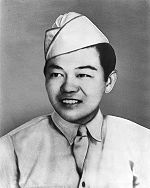
Private First Class Sadao S. Munemori 1922 – 1945


Sadao S. Munemori born August 17, 1922 – April 5, 1945, was a posthumous recipient of the Medal of Honor, after he sacrificed his life to save those of his colleagues at Seravezza, Italy during the closing stages of World War II. Munemori was a private first class in the United States Army, in Company A, 100th Infantry Battalion, 442nd Regimental Combat Team.
Munemori was born in Los Angeles, California. In 1942, shortly after he volunteered for the U.S. Army, Munemori's parents and siblings were incarcerated at the Manzanar internment camp for Japanese Americans.

Medal of Honor Citation

100th Infantry Battalion, 442d Combat Team. Place and date: Near Seravezza, Italy, 5 April 1945. Entered service at: Los Angeles, Calif Birth: Los Angeles, Calif. G.O. No.. 24, 7 March 1946. Citation: He fought with great gallantry and intrepidity near Seravezza, Italy. When his unit was pinned down by grazing fire from the enemy's strong mountain defense and command of the squad devolved on him with the wounding of its regular leader, he made frontal, l-man attacks through direct fire and knocked out 2 machineguns with grenades Withdrawing under murderous fire and showers of grenades from other enemy emplacements, he had nearly reached a shell crater occupied by 2 of his men when an unexploded grenade bounced on his helmet and rolled toward his helpless comrades. He arose into the withering fire, dived for the missile and smothered its blast with his body. By his swift, supremely heroic action Pfc. Munemori saved 2 of his men at the cost of his own life and did much to clear the path for his company's victorious advance.